

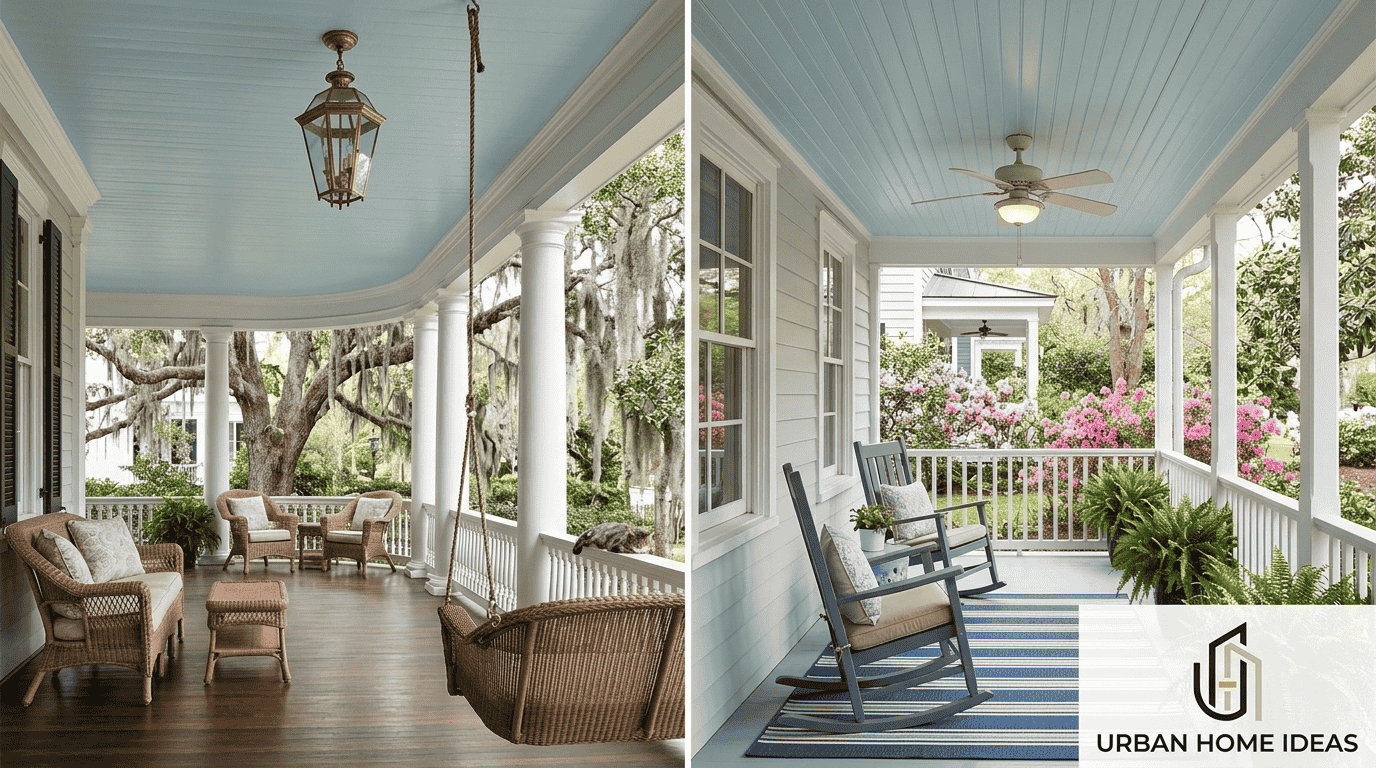
A haint blue porch ceiling brings together Southern tradition, Southern architecture, and practical exterior design in one distinctive feature. Usually seen as a soft blue, watery blue, pale blue, or blue-green overhead surface, it has roots in Gullah culture, folklore, history, and ideas of protection, while modern homeowners often choose it simply for its beauty and calming character.
- What Is Haint Blue And Why Are Southern Porch Ceilings Painted Blue?
- Haint Blue Porch Ceiling Meaning
- Do Haint Blue Porch Ceilings Keep Bugs Away?
- Best Haint Blue Paint Colors For Porch Ceilings
- Haint Blue Porch Ceiling Makeover / Personal Experience
- Blue Porch Ceiling Design Ideas
- How To Use Haint Blue In Modern Homes
- Bottle Trees And Their Connection To Haint Blue
- Haint Blue Paint Colors By Sherwin-Williams
- Haint Blue Paint Colors By Benjamin Moore
- Other Haint Blue Paint Brands
- How To Choose The Right Haint Blue
- Understanding Light Reflectance Value (LRV)
- Balancing Blue And Green Undertones
- Avoiding Shades That Feel Too Strong
- Frequently Asked Questions About Haint Blue Porch Ceiling
What Is Haint Blue And Why Are Southern Porch Ceilings Painted Blue?
A blue ceiling can look like a straightforward decorative decision, but its background is considerably deeper. The historical tradition is associated with the Lowcountry, particularly South Carolina and Georgia, where the color became part of the visual identity of many Southern homes.
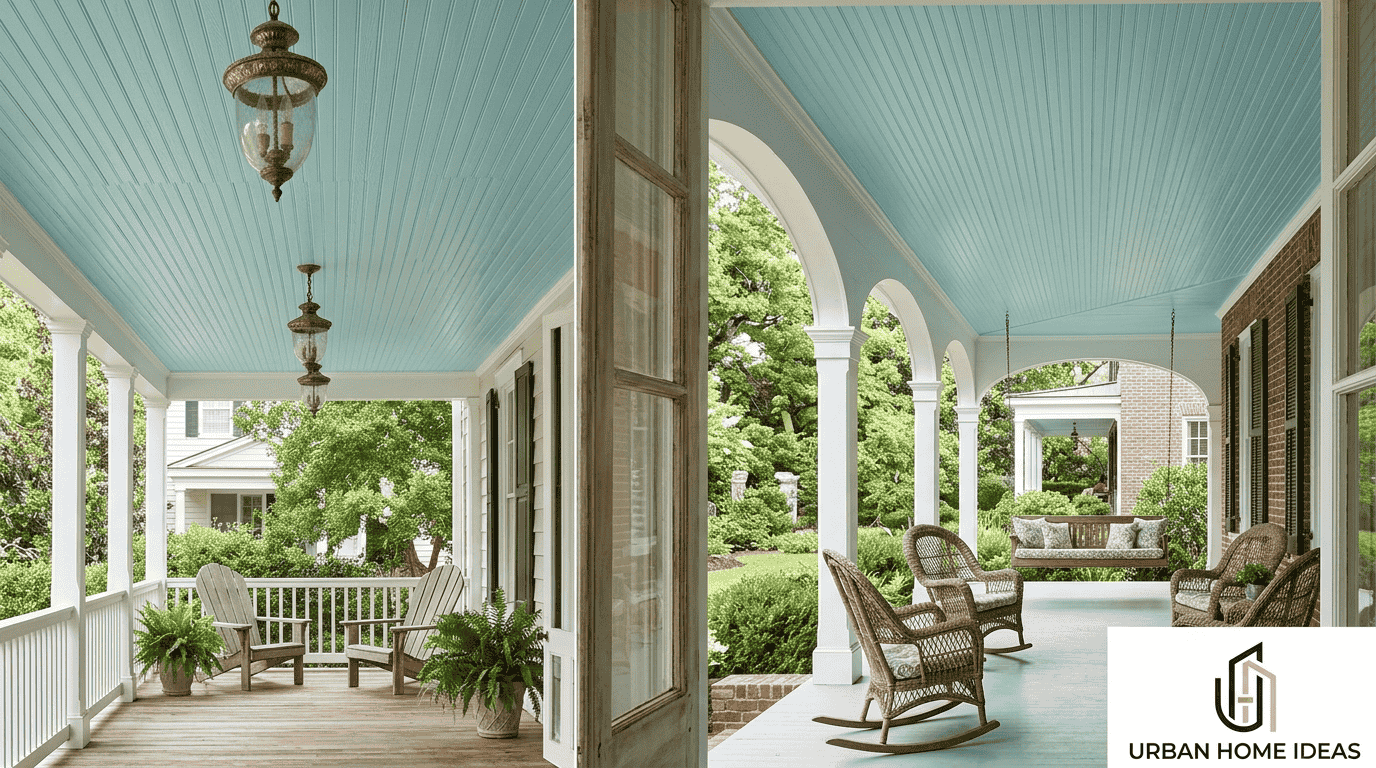
The tradition is especially associated with the Gullah people and Gullah Geechee communities of the coastal American South. These communities included descendants of enslaved Africans whose cultural practices helped shape the region. Historical blue finishes could involve indigo, indigo-derived pigment, lime, milk, and other natural ingredients.
The result was not necessarily one standardized shade. Historic surfaces could appear as blue-green colors, watery blue, pale blue, or straightforward blue paint.
Haint Blue Porch Ceiling Meaning
The haint blue porch ceiling meaning begins with the word haint, a regional variation of haunt referring to troublesome spirits. According to traditional folklore and superstition, evil spirits, restless spirits, or negative spirits could be discouraged by blue-painted architectural surfaces.
The belief centered on water and the sky. Because spirits could not cross water, a blue surface could symbolically resemble water. A ceiling resembling the open sky offered another visual interpretation. This idea of protection from spirits extended beyond a porch ceiling to porch ceilings, ceilings, doors, shutters, and window frames around homes.
That historical explanation gives haint blue more depth than a typical exterior color. Its story connects protection, culture, cultural history, memory, survival, and emotional connection.
Places such as Charleston and Savannah are strongly associated with this traditional appearance, while locations such as Georgetown also demonstrate the broader regional character. Today, the same color can create a brighter porch, establish visual calm, and connect a home with nature, exterior architecture, decorative tradition, and its historical roots.
Do Haint Blue Porch Ceilings Keep Bugs Away?
No. Scientific evidence does not establish that haint blue porch ceilings actively repel bugs. Although this tradition is often connected with fewer insects, the ceiling color itself should not be treated as reliable pest control, an insect repellent, or a bug repellent.
The interesting part is why the claim has survived. Some historical reasons behind haint blue involve old beliefs surrounding blue-painted porch ceilings, while the practical reasons are less certain. One common practical explanation suggests that insects could mistake a blue porch ceiling for open sky. However, that idea does not mean blue paint will actually repel bugs.
From a practical painting and exterior-design perspective, a homeowner may still find bugs or other insects around a painted porch. For that reason, the historical tradition of a blue ceiling should be appreciated separately from modern claims about insect prevention.
Best Haint Blue Paint Colors For Porch Ceilings
There is no need for modern haint blue paint to match one rigid historical formula. Today’s choices range from aqua and teal to sky blue, muted blue, blue-gray, and aquamarine.
A successful porch ceiling paint depends as much on its surroundings as the chip itself. Exterior lighting, natural light, daylight, house exterior color, trim color, furniture, flooring, and other surrounding materials can alter the appearance dramatically.
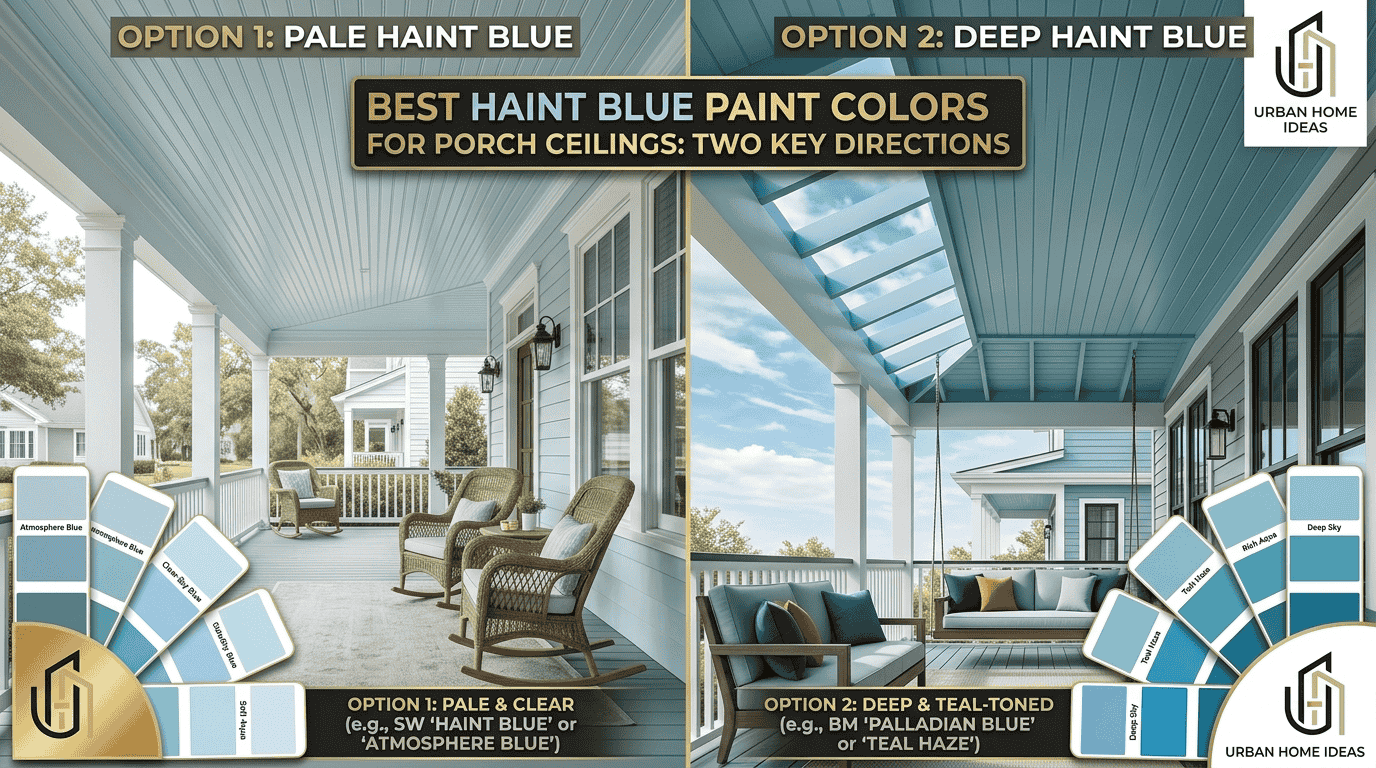
That is why experienced painters rely on paint samples, color samples, and test samples before finalizing a paint shade. The amount of saturation, the balance of blue undertones and green undertones, and the overall color selection all matter.
A historical haint blue may feel different from a modern haint blue, but both can work with a beadboard ceiling or smooth blue ceiling. Some homeowners want a calm color or airy color, while others prefer a stronger exterior color. Either approach can maintain a traditional Southern appearance when the exterior paint and architecture work together.
Haint Blue Porch Ceiling Colors
Popular haint blue porch ceiling colors cover a surprisingly broad spectrum. There are no universally required haint blue colors or porch ceiling colors.
A restrained palette can include subtle blue, airy blue, soft blue, pale blue, or light blue. More visible alternatives include slate blue, stronger blue, beach-inspired blue, and historic blue. Between those extremes are balanced blue-green, blue-green, aqua, teal, muted blue, blue-gray, aquamarine, and watery blue.
The right choice should account for exterior colors, natural light, exterior lighting, saturation, undertones, blue undertones, and green undertones. It should also be viewed beside white trim, gray, natural wood, and warm wood tones, as well as the home’s house exterior color, flooring, furniture, and other surrounding materials.
Useful paint samples and color samples include Rainwashed SW 6211, Atmospheric SW 6505, Lauren’s Surprise SW 6791, Tradewind SW 6218, Sea Salt SW 6204, Pool Blue, Topsail SW 6217, Niebla Azul SW 9137, Palladian Blue HC-144, Wythe Blue HC-143, Smoke 2122-40, Woodlawn Blue, Harbor Haze, Sky Light View, Parma Gray No. 27, Porch Ceiling, Skylight, Rain, and Waterscape.
Each produces a different traditional appearance, so the surrounding Southern architecture should guide the final choice.
Sherwin Williams Haint Blue
There is no single official Sherwin Williams haint blue, which is useful because different homes need different levels of color.
Rainwashed SW 6211 offers a soft blue-green and calming blue-green direction. Atmospheric SW 6505 moves toward pale blue and airy sky blue, while Lauren’s Surprise SW 6791 supplies a brighter blue, more energetic blue character.
For a softer effect, Tradewind SW 6218 and Sea Salt SW 6204 can create a light blue or subtle blue-green appearance. Pool Blue introduces a beach-inspired blue, while Topsail SW 6217 brings muted blue and muted green undertones. Niebla Azul SW 9137 provides a deeper slate blue with more saturation. Rain and Waterscape offer further directions worth sampling.
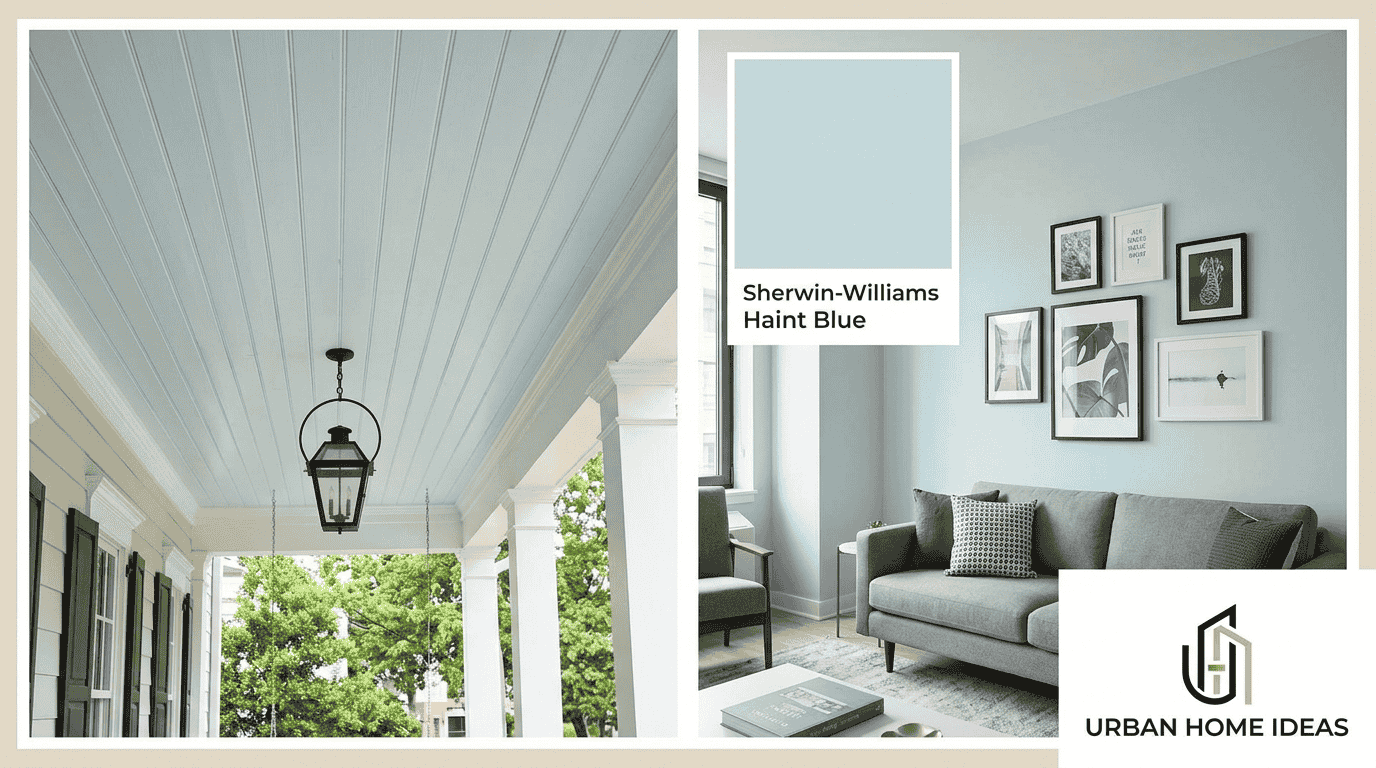
Before using any of them on a haint blue porch ceiling, the homeowner should examine the porch ceiling in strong exterior sunlight and changing natural light. Exterior lighting, daylight, nearby white trim, and the existing exterior paint can change how the shade reads.
Using physical paint samples is therefore more reliable than choosing from a screen. The goal is a blue-green ceiling that suits the Southern porch and traditional porch ceiling, rather than selecting a shade only by name. Good color selection always considers the finished paint shade in its actual setting.
Haint Blue Porch Ceiling Benjamin Moore
For someone searching for a haint blue porch ceiling Benjamin Moore option, several established shades offer different interpretations.
Palladian Blue HC-144, also called Palladian Blue, is a particularly adaptable soft blue with a balanced blue-green appearance. Its blue characteristics and green characteristics can shift depending on light.
Wythe Blue HC-143, or Wythe Blue, offers a more historic blue direction and is associated with the Williamsburg Collection. Smoke 2122-40, commonly shortened to Smoke, creates a muted blue-gray effect. Woodlawn Blue can lean toward aquamarine, while Harbor Haze offers another muted blue-green option.
These shades can work beside white, gray, and white trim, but the correct result depends on exterior lighting, natural light, and the overall color balance. Physical paint samples should be viewed on the actual porch ceiling.
A traditional Southern blue can suit both traditional design and modern design. Whether applied to a front porch stoop or back porch, the chosen exterior paint should provide enough noticeable color to complement the surrounding architecture, Southern architecture, and existing exterior color without overwhelming them.
Haint Blue Porch Ceiling Makeover / Personal Experience
A successful makeover does not begin with blue alone. It begins by looking at everything around the ceiling.
Haint Blue Ceiling
A haint blue ceiling can transform an exterior ceiling without requiring major architectural work. On a beadboard ceiling, even a subtle blue can create depth that plain white often lacks.
Consider a porch with yellow-toned trim and hunter-green shutters. During an exterior update, changing those elements to white walls and cleaner window trim can completely alter how a blue ceiling appears. A shade such as Sea Salt may create a restrained blue-green ceiling, while Palladian Blue offers a more balanced blue-green alternative. Simply White can provide a neutral framework around either.
In hands-on porch makeover work, one practical issue is often overlooked: reflected blue light. If a living room sits immediately behind a porch, a highly saturated ceiling can influence the light entering the room. That makes a soft blue-green, soft color, or calm color useful when a quieter effect is preferred.
The same paint can look different on a front porch stoop and back porch because natural light and exterior daylight change throughout the day. Applying paint samples before committing allows the homeowner to judge the color against the surrounding architecture and exterior architecture.
Once the haint blue porch ceiling is complete, furnishings can reinforce the relaxed traditional Southern appearance. Glider rocking chairs, a wicker sofa, bistro furniture, an outdoor rug, and patterned pillows can turn the outdoor space into a comfortable Southern porch with enough noticeable color to feel intentional.
Blue Porch Ceiling Design Ideas
A blue porch ceiling works best when treated as part of the entire porch design, not as an isolated decorative surface.
A haint blue porch ceiling over a beadboard ceiling creates texture before furniture is even introduced. Adding white trim provides crisp contrast, while stained wood and warm wood tones prevent a cool blue-green ceiling from making the space feel visually cold.
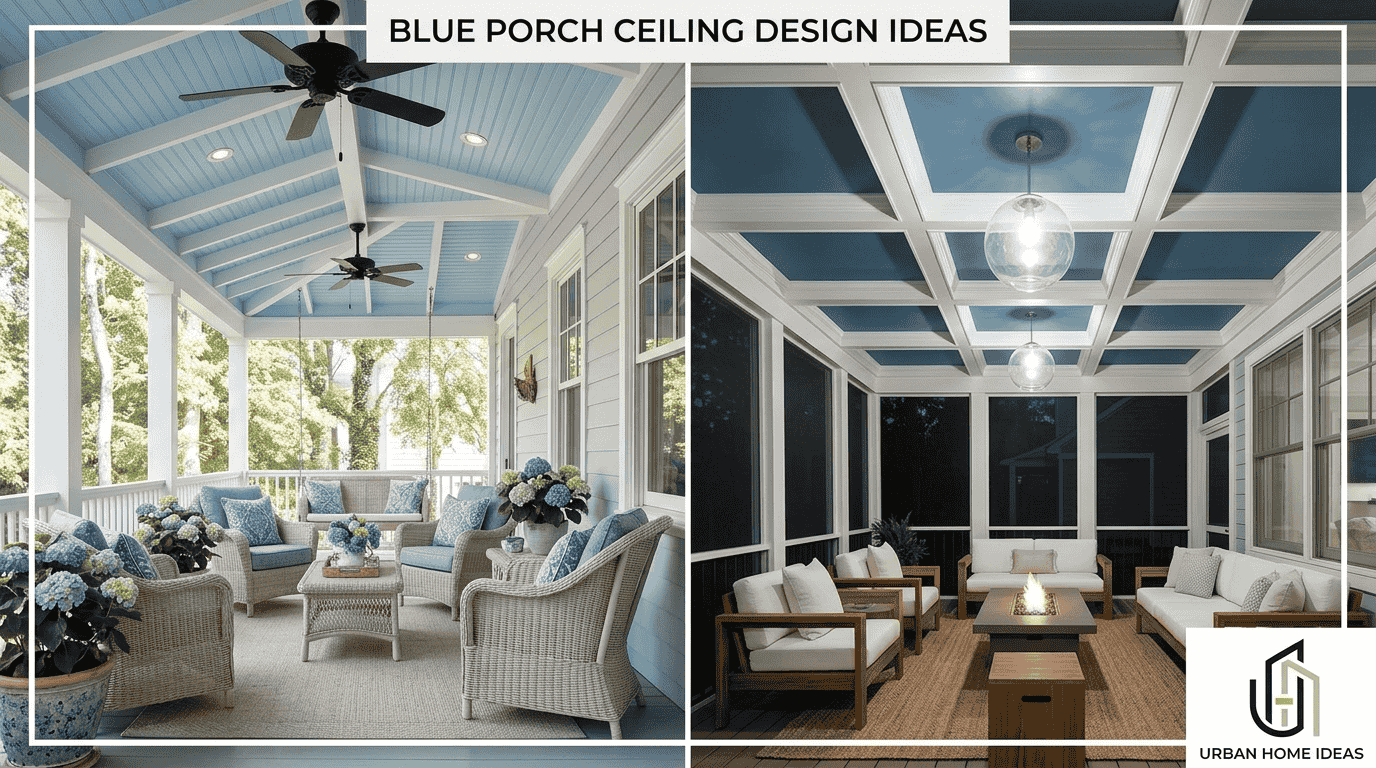
Furniture can continue that balance. Teak furniture, rattan furniture, rocking chairs, Southern-style rocking chairs, and porch swings naturally complement the relaxed character of a Southern design. Lantern lighting adds architectural definition after sunset, while natural outdoor textures and other natural materials keep the scheme grounded.
The result does not need to feel like a period recreation. Although haint blue carries a historical tradition and superstitious origins, it can operate as a contemporary design feature or decorative feature.
A restrained ceiling color, carefully chosen porch furniture, and comfortable outdoor furniture allow the historical reference to sit naturally within modern exterior design, exterior architecture, Southern architecture, and an inviting outdoor space.
How To Use Haint Blue In Modern Homes
Haint blue can move beyond a haint blue porch ceiling without losing its identity. Although traditionally used across Southern porch ceilings, this pale blue-green shade can introduce a calm, historic touch to modern homes. The key is treating it as a flexible ceiling color rather than limiting it to one architectural style.
For a modern approach, designers can carry the pale blue-green tone from porch ceilings into selected interior or exterior details. A restrained shade works especially well when the surrounding home design is simple, allowing the color to add character without making the space feel overly traditional.
Its historic connection can also be preserved through thoughtful traditional use. In a Southern property, for example, the color can remain overhead on a porch while cleaner finishes and contemporary furnishings give it new context. This is one of the easiest fresh ways to respect the color’s background while adapting it to present-day architecture.
Bottle Trees And Their Connection To Haint Blue
The story of haint blue becomes more interesting when considered beside bottle trees, another tradition associated with Southern and Gullah tradition.
Traditionally, blue glass bottles, ordinary glass bottles, or specifically blue bottles could be placed as upside down bottles on tree branches. In regional folklore, these objects were associated with wandering spirits and the idea of trapped spirits.
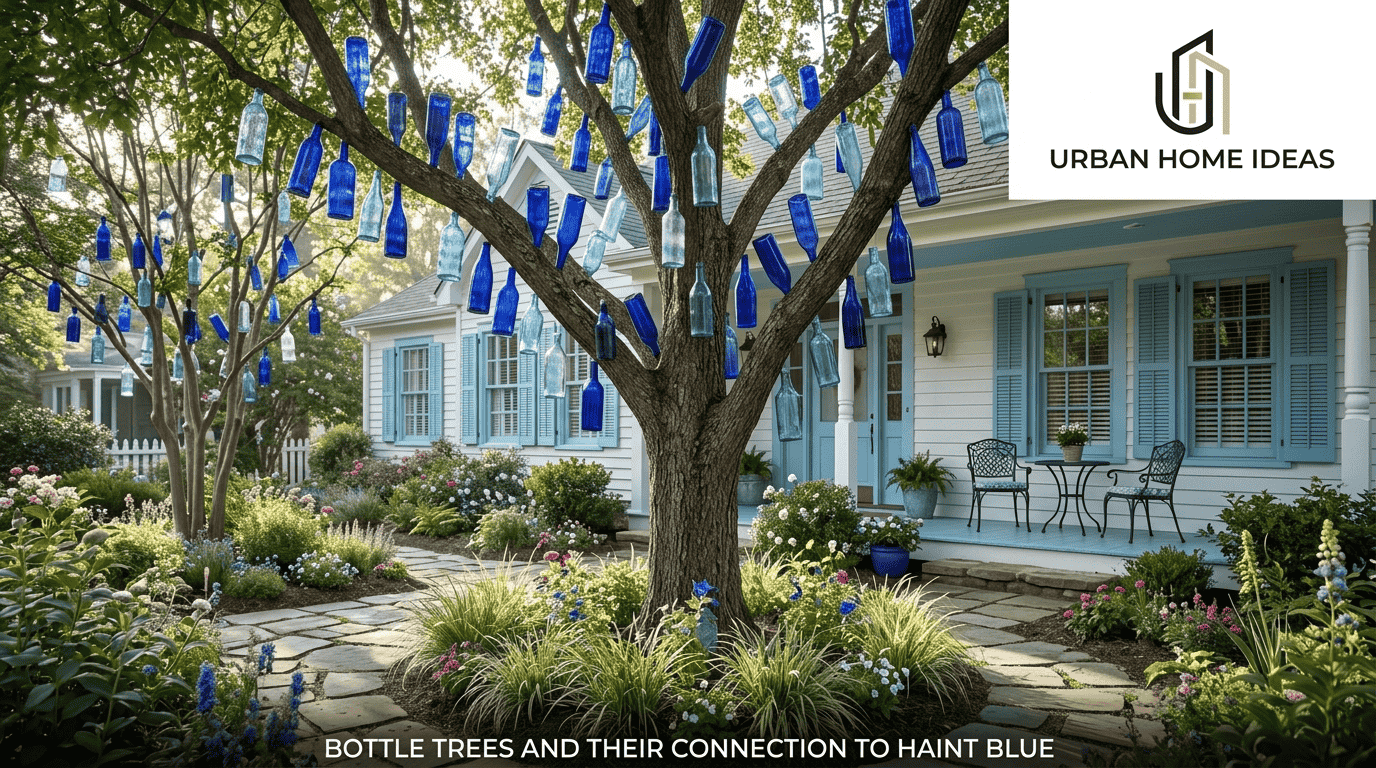
Like blue-painted architectural surfaces, the practice connects protection with color and place. Its historical meaning and spiritual meaning show why apparently simple decorative elements can carry deeper cultural symbolism.
Today, bottle trees may appear in Southern gardens simply as garden decoration, but their background belongs to a wider Southern tradition. Understanding that context connects the objects with cultural history, Southern culture, inherited stories, tradition, gardens, and the symbolic use of blue color.
Haint Blue Paint Colors By Sherwin-Williams
Rainwashed
Rainwashed, identified as SW 6211, offers a soft blue-green appearance that can feel like a calming blue-green overhead. As haint blue, it works particularly well when a porch ceiling needs understated blue-green paint rather than strong saturation. The exterior paint creates a soft color and calming color suitable for a Southern porch where the ceiling color should remain gentle.
Lauren’s Surprise
Lauren’s Surprise, SW 6791, is a brighter blue with a more energetic blue personality. Used as haint blue on a porch ceiling, this blue paint can become a more noticeable exterior paint choice. Its bright color works for a Southern porch where the homeowner wants the ceiling color to be clearly visible.
Atmospheric
Atmospheric, SW 6505, leans toward pale blue and an airy sky blue appearance. That makes it a convincing haint blue candidate for a porch ceiling intended to echo sky color. As exterior paint, the light blue can keep a Southern porch bright without making the ceiling color dominant.
Tradewind
Tradewind, SW 6218, offers a light blue that can sit comfortably beside white trim. As haint blue on a porch ceiling, the exterior paint becomes especially crisp beside bright white trim. Its soft blue character suits a Southern porch needing a restrained ceiling color.
Sea Salt
Sea Salt, SW 6204, is known for a subtle blue-green appearance. Under strong exterior sunlight, this haint blue option can become especially quiet on a porch ceiling. The blue-green paint responds noticeably to exterior daylight and natural light, making its subtle color useful for a relaxed Southern porch and understated ceiling color.
Pool Blue
Pool Blue offers a stronger blue and distinctly beach-inspired blue direction. Used as haint blue on a porch ceiling, the blue paint creates a more assertive exterior paint treatment. Its saturated blue character works best on a Southern porch where a prominent ceiling color is intentional.
Topsail
Topsail, SW 6217, is a muted blue with noticeable green undertones. As haint blue for a porch ceiling, its blue-green paint can work as quiet exterior paint. The muted color is particularly suitable for a Southern porch where the ceiling color should support rather than dominate the architecture.
Niebla Azul
Niebla Azul, SW 9137, offers a deeper slate blue with greater saturation. Homeowners wanting stronger haint blue on a porch ceiling can use this slate blue as a more dramatic exterior paint choice. Its saturated color gives a Southern porch a clearly defined ceiling color.
Haint Blue Paint Colors By Benjamin Moore
Palladian Blue
Palladian Blue, HC-144, combines soft blue with blue-green and subtle green characteristics. Its balanced blue-green quality makes it a versatile haint blue for a porch ceiling.
As a Southern blue exterior paint, it can work across a front porch stoop or back porch. Its traditional Southern appearance complements the surrounding architecture while still offering enough noticeable color to distinguish the ceiling.
Wythe Blue
Wythe Blue, HC-143, provides a historic blue character and belongs to the Williamsburg Collection. As haint blue, it can bring more historical personality to a porch ceiling. This blue paint has the feel of a historical color, making it suitable for traditional design, heritage-inspired exterior paint, and Southern architecture.
Smoke
Smoke, 2122-40, creates a muted blue-gray or straightforward blue-gray appearance. Used as haint blue on a porch ceiling, it can bridge traditional design and modern design. The restrained exterior paint, muted blue, and softer ceiling color are useful when brighter blues feel too decorative.
Woodlawn Blue
Woodlawn Blue has an aquamarine quality that can read as aquamarine blue outdoors. Used as haint blue for a porch ceiling, the blue-green color gives exterior paint a fresh character. It is particularly suitable for a Southern porch needing a light, approachable ceiling color.
Harbor Haze
Harbor Haze is a muted blue-green that works comfortably with white and gray. As haint blue on a porch ceiling, the blue-green paint can complement exterior paint, white trim, and a gray exterior. This makes it an adaptable choice for a Southern porch where the ceiling color needs to coordinate rather than compete.
Other Haint Blue Paint Brands
Sky Light View
Sky Light View offers a very pale blue and airy sky blue effect. Used as haint blue on a porch ceiling, this pale blue paint creates subtle exterior paint color. Its light blue appearance is useful when the desired ceiling color for a Southern porch should be barely stronger than the sky.
Parma Gray No. 27
Despite its name, Parma Gray No. 27 can read distinctly blue. It offers a contemporary interpretation of traditional haint blue, making it useful when haint blue is wanted on a porch ceiling without an overly historical effect. The contemporary design, blue paint, and durable-looking exterior paint character can establish a refined ceiling color.
How To Choose The Right Haint Blue
Choosing the right haint blue for a haint blue porch ceiling depends on more than selecting a popular paint name. The ideal shade usually balances a soft blue-green appearance with a subtle tint that feels open and comfortable. A proper color selection considers the porch environment, surrounding materials, and how the shade reacts under changing light.
A common mistake is assuming every blue ceiling will create the same effect. In practice, the final paint appearance changes based on natural light, exterior lighting, and the surface where the color is applied. A soft shade can look brighter during daylight, while a deeper option may appear more dramatic in shaded areas.
Understanding Light Reflectance Value (LRV)
Paint professionals often use Light Reflectance Value or LRV to understand how much light a color reflects. For a haint blue porch ceiling, a range between 55 and 75 can help create an airy appearance without becoming too intense.
A higher LRV generally produces more reflected brightness, while lower values can make a color feel richer. This is why a homeowner may prefer a balanced blue-green blend or blue-gray blend instead of an overly saturated shade.
The goal is usually a ceiling that feels relaxed rather than overwhelming. A carefully chosen ceiling color with the right light reflectance can maintain the traditional character of haint blue while working with modern exterior styles.
Balancing Blue And Green Undertones
The personality of haint blue often comes from the relationship between blue tones and green undertones. Some shades lean closer to a muted blue, while others create a softer coastal feeling through a blue-green mix.
A blue-green blend can make a porch feel calm, while a blue-gray blend may create a more classic and refined appearance. The right choice depends on the existing porch color, architecture, and nearby finishes.
Before committing to an exterior paint, experts recommend testing samples directly on the ceiling. This helps reveal how the paint shade behaves throughout the day and prevents surprises after the full application.
Avoiding Shades That Feel Too Strong
Although bold colors can be attractive, a haint blue porch ceiling usually works best when it avoids appearing like an intense blue or dark blue. The purpose is often to create an open, breathable feeling rather than a heavy overhead surface.
A balanced shade allows the ceiling to complement the home without competing with other exterior elements. Factors such as brightness, saturation, and blue saturation influence whether the final result feels soft and traditional or too powerful.
By reviewing the right haint blue options in real lighting conditions, homeowners can select a ceiling color that keeps the historic charm while fitting naturally into the overall exterior design.
Frequently Asked Questions About Haint Blue Porch Ceiling
What Is The Purpose Of A Haint Blue Porch Ceiling?
A haint blue porch ceiling was traditionally used for protection through folklore and traditional belief. The main purpose was to ward off evil spirits by creating a symbolic barrier around homes. This blue porch ceiling became part of Southern tradition and exterior design. Some also believed it could deter insects, making it a possible pest deterrent, although modern insect prevention relies on other methods. Today, haint blue represents spiritual protection, history, and a meaningful ceiling color choice.
What Is The Best Haint Blue Paint Color For A Porch Ceiling?
The haint blue porch ceiling color selection often depends on the atmosphere a homeowner wants to create. The best haint blue paint color is widely considered Benjamin Moore Palladian Blue, also known as HC-144, because it offers a soft blue appearance with a balanced blue-green shade. This top choice works well as a calming ceiling color while maintaining the character of a traditional Southern exterior.
What Is The Story Behind Haint Blue?
The haint blue porch ceiling has a history connected with Southern tradition, folklore, and cultural practices of the American South. The story behind haint blue begins with a pale blue-green paint traditionally applied to porch ceilings, doors, and window frames as a symbolic form of protection against malicious spirits known as haints.
The origins of haint blue are closely linked with Gullah culture, Gullah Geechee communities, and the Lowcountry regions where color carried deeper meanings beyond decoration. The use of this blue-green paint became part of Southern homes, combining cultural history with practical exterior paint choices.
What Are Haint Colors?
Haint blue porch ceiling colors are recognized as haint colors connected with folklore, Southern tradition, and historic design. This soft shade of blue-green was traditionally used on porch ceilings, doors, and window frames in the American South. The pale blue-green shade became linked with protection, spiritual protection, and cultural practices of Gullah culture, Gullah Geechee, and Lowcountry communities.
Other Post
Home Hacks Wutawhacks: Best Cleaning & Storage Hacks
What Is The Average Cost To Build A Barndominium?
Whole Home Remodeling: Complete Transformation, Smart Planning & Modern Design Ideas
How Much Is Cord Of Wood? Size, Cost, Weight & Firewood Facts