

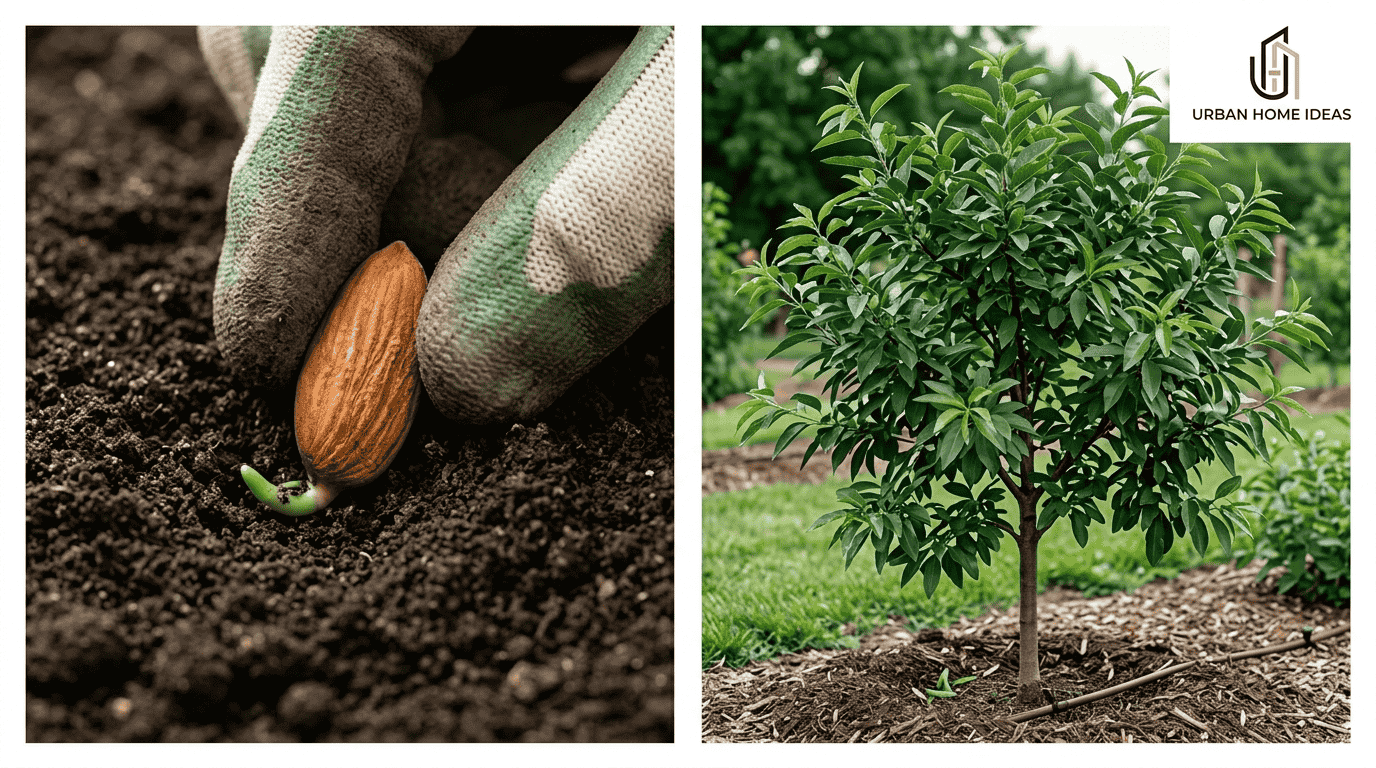
To understand how do you grow an almond tree, start with well-draining soil, a sunny site, proper watering, and the right climate. Healthy almond trees need careful planting, enough sunshine, good drainage, and protection from harsh weather. With patient cultivation, the tree establishes healthy roots and eventually produces edible nuts.
- How Do You Grow An Almond Tree?
- How To Plant An Almond Tree
- Best Location For Growing Almond Trees
- Soil Preparation And Drainage
- Spacing Almond Trees
- Sunlight Requirements
- Watering Almond Trees
- Best Time To Plant An Almond Tree
- Fertilizing Almond Trees
- Staking And Supporting Young Almond Trees
- Growing Almond Trees In Containers
- Pruning Almond Trees
- Pollination
- Harvesting Almonds
- Almond Tree Diseases And Pests
- Types Of Almond Trees
- Sweet Almond Vs. Bitter Almond
- Temperature And Climate Requirements
- Propagating An Almond Tree
- Growing Almond Trees From Almonds
- Size And Rootstocks
- Almond Tree Varieties For UK Growing
- Establishing Bare-Root Almond Trees Before Transplanting
- FAQ
- Other Post
An almond tree brings more than a future crop to a garden. Almond trees can be ornamental and nut-producing, with an attractive appearance and early spring blossom. Once fruit develops, each edible almond is protected by a green hull and hard shell. However, productive trees often require several years before producing almonds.
For successful growth, young bare-root trees need thoughtful site selection, careful transplanting, sufficient warmth, and shelter from unfavorable conditions. Once these fundamentals are understood, growing almond trees becomes relatively straightforward.
How Do You Grow An Almond Tree?

A gardener asking how do you grow an almond tree can start an almond tree with raw seeds or a young sapling. Unroasted seeds and viable seeds benefit from stratification, a controlled chilling process involving chilling. Careful planting in well-draining soil at a sunny spot creates suitable soil conditions for healthy growing and steady root development.
How To Plant An Almond Tree
The first task is giving the roots enough room to establish naturally. Bare-root almond trees are normally planted while dormant, often during late winter or early spring.
A sufficiently large planting hole should accommodate the long taproot without bending it. For potted trees, the grower should generally maintain the existing soil depth. With bare-root trees, the root flare should remain around the natural soil level.
Root placement deserves careful attention. Loose soil gives young roots space to spread rather than becoming bent or cramped. Depending on root size and site preparation, an area around 70 cm wide and 90 cm deep may provide enough room for the roots to sit comfortably.
After bare-root planting, surrounding soil should be gently firmed so large air pockets do not remain. The gardener should water immediately. Suitable fertilizer may also be considered according to existing soil fertility.
Newly planted trees should be watered thoroughly. Applying mulching material can reduce moisture loss. A suitable layer of mulch can later retain moisture and suppress weeds.
Where windy locations expose a young tree to movement, it may be staked for temporary support. Support stakes are especially useful where strong winds repeatedly move the trunk.
Container-grown trees may be planted later, but they still require consistent watering until properly established. In suitable climates, November through February can coincide with useful dormancy conditions, including in parts of the UK.
Best Location For Growing Almond Trees
The ideal location combines warmth, light, drainage, and shelter. A tree receiving around 6–8 hours of direct sunlight has a stronger foundation for flowering and fruit development.
A sunny site with excellent drainage is generally preferable. Heavy clay can be unsuitable when it retains excessive moisture around the root zone. Before planting, a gardener should also consider the position of an underground sewer or other water infrastructure.
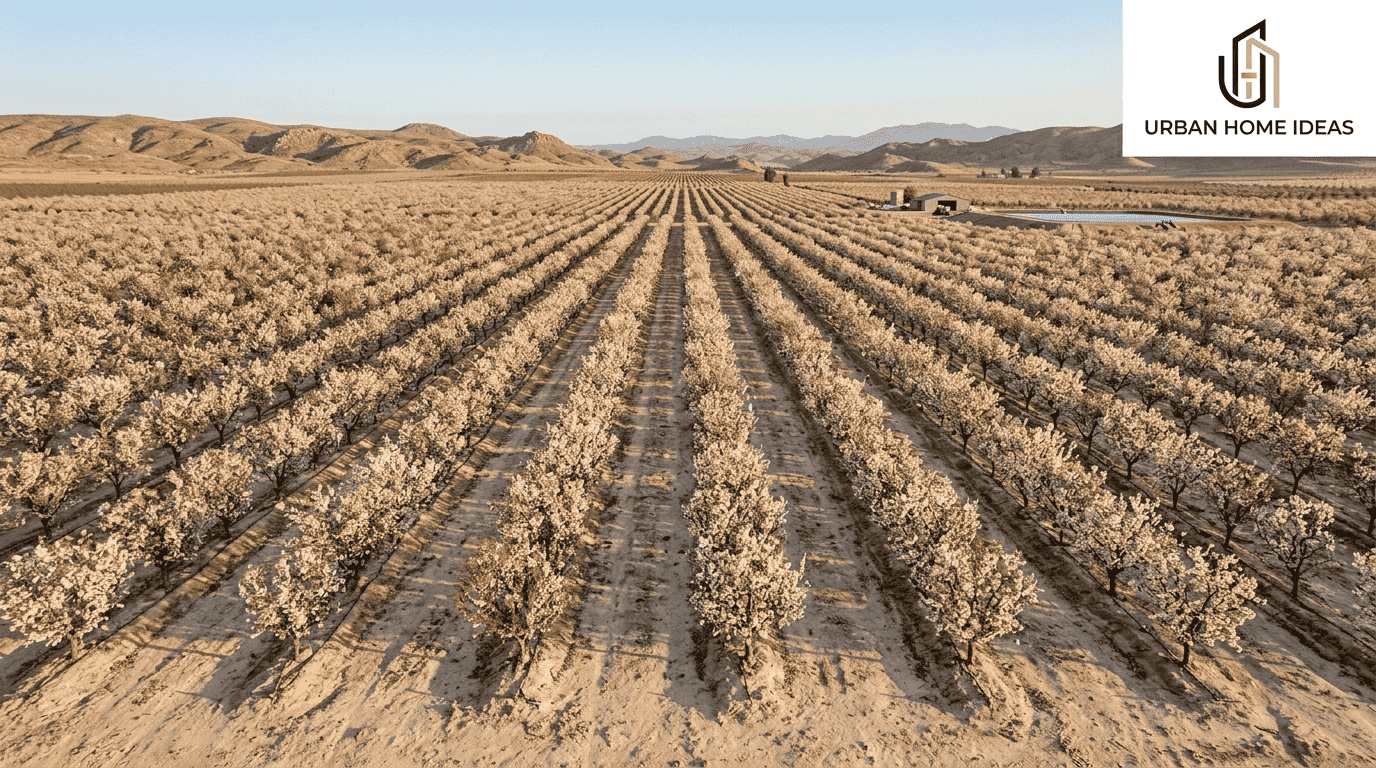
Special care may be useful with young trees. If the final growing location is particularly cold or windy, temporary protection can reduce stress. A young specimen may sometimes be kept sheltered beside a wall before being moved to its permanent location.
Mature trees perform better in warm, sunny conditions than in persistently damp locations. Shelter from north winds and easterly winds adds valuable protection.
This becomes particularly important when early flowers appear because spring frost can damage them. A protected orchard position or warm south-facing wall can provide a more favorable growing environment.
Soil Preparation And Drainage
Root health largely depends on what happens after rainfall. Almonds favor well-draining soil, and sandy soil can be particularly suitable. A soil pH around 6.0–7.0 provides a useful general range.
By contrast, heavy soil and poorly drained clay soils can cause serious root problems.
Good deep soil preparation gives developing roots an opportunity to penetrate downward rather than remaining confined near the surface. Starting with loose ground and properly prepared ground also allows young roots to develop and spread.
The planting hole needs to be sufficiently wide and deep for the entire root system to fit comfortably. A substantial depth of cultivated topsoil and workable soil is preferable to heavily compacted soil.
Suitable organic material can be incorporated during soil preparation where necessary. Preparing the planting site several weeks beforehand also gives disturbed ground time to settle.
Spacing Almond Trees
Young plants can make an orchard look empty, but future canopy size matters. Trees need to be properly spaced from the beginning.
Around 15–20 feet apart can work for many plantings. Approximately 5 metres can also provide practical spacing between almond trees, depending on cultivar, training system, and available space.
Sunlight Requirements
Light influences both tree growth and flowering. Almond trees generally perform best with around 6–8 hours of full sun each day.
This adequate sunlight supports flowering and future nut production. Choosing a sunny garden position also encourages successful long-term growth.
Generous sunshine can make sunny locations more favorable for pollinating insects. In comparison, cold and shaded positions can provide less favorable conditions during bloom.
Watering Almond Trees
Almonds are often associated with warm regions, but that does not mean they can simply be ignored during dry periods. Almond trees require substantial moisture, particularly while nuts are developing.
The soil should stay adequately moist, not permanently waterlogged. Continual excess water can contribute to root rot, making drainage just as important as irrigation.
Newly planted trees should be thoroughly watered. For established young trees, watering once every two weeks might sometimes suit summer, although soil texture, rainfall, and temperature should determine the actual schedule.
Additional watering may become necessary during warm conditions or prolonged dry conditions. Following planting, the grower should water immediately, especially with container-grown trees.
Young specimens deserve close watering attention during establishment and throughout the first summer. Their water demand usually declines when autumn conditions become cooler.
Best Time To Plant An Almond Tree
Tree condition matters as much as the calendar. Bare-root seedlings are usually planted while dormant, commonly during late winter or early spring.
Where conditions permit, planting ahead of suitable rainy weather can support early establishment.
In other climates, trees may be transplanted into the ground during cooler autumn weather. Consistent regular rainfall can reduce the pressure of immediate irrigation.
A period from November to February can suit bare-root trees where winters are appropriate for planting.
Container-grown specimens provide more flexibility and can sometimes go into the ground during late spring or summer. Nevertheless, working during dormancy can help minimize transplant stress.
Fertilizing Almond Trees
Feeding should support the tree rather than replace healthy soil. A balanced fertilizer may be useful during spring when additional nutrients are needed.
It can be distributed around the tree near the drip line, always following product instructions rather than assuming that more fertilizer creates faster growth.
Appropriate fertilizer may also be considered around the planting hole, depending on soil conditions and product directions. The grower should water thoroughly after planting.
Existing nutrients and previous soil preparation should influence future feeding decisions. Container-grown trees need especially careful ongoing nutrient replacement because they depend on a limited growing medium managed by the gardener.
Staking And Supporting Young Almond Trees
Not every young tree needs a permanent support structure. Staking is most useful when trees are trying to establish in exposed windy sites.
Tree ties should remain sufficiently loose to permit some natural movement. The purpose of initial support is to protect the root system during establishment, not to prevent the trunk from moving at all.
Where a growing site experiences strong winds, support sticks can stabilize vulnerable plants. Young container trees may similarly be supported before being transplanted.
Support can sometimes remain useful through the first year or even two years. After sufficient establishment, permanent staking is generally unnecessary.
Growing Almond Trees In Containers
Containers can be useful, but they introduce limitations. Even dwarf almonds may eventually become unsuitable for permanent container cultivation.
For temporary establishment, temporary bags or pots can hold bare-root trees before transplanting them into the ground.
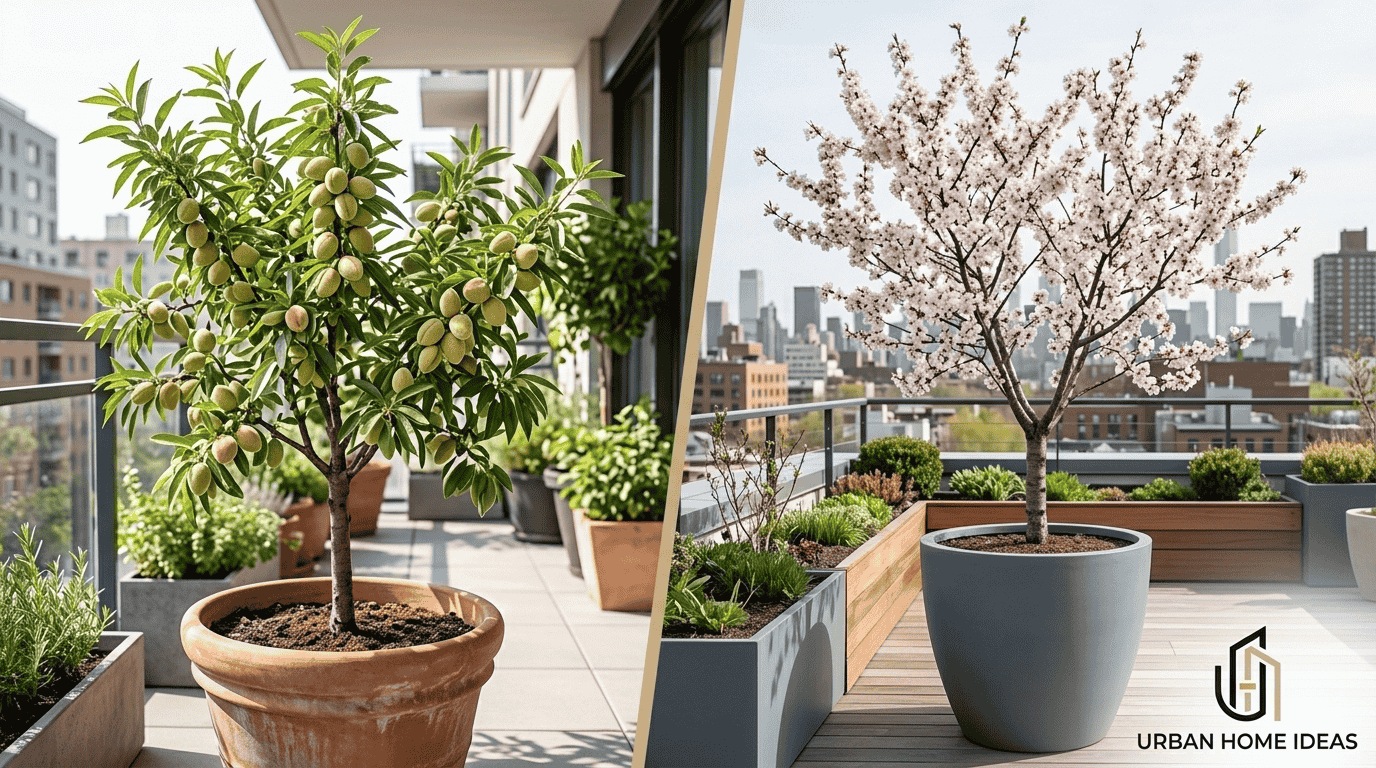
Proper drainage holes are essential. Well-managed temporary containers allow young trees to strengthen before exposure to a windy permanent location.
Long-term container growing requires a large container. Container trees also rely heavily on the gardener for water and nutrients because their roots cannot explore surrounding soil.
A warm, sunny location remains preferable even when the tree is container-grown.
Pruning Almond Trees
Pruning should create a functional canopy rather than simply make the tree look tidy. Annual dormant-season pruning can support long-term health and productivity.
Priority material includes dead branches, damaged branches, crossing branches, inward-growing branches, and other poorly positioned branches.
Removing problematic growth improves airflow and allows more sunlight to reach the centre of the canopy.
With young trees, selected shoots can be shortened to encourage bushier development. Some lower branches may also be removed when creating a clear trunk.
During later pruning, attention can shift toward maintaining an open centre and removing dead wood and unproductive wood.
Pollination
Variety selection can determine whether flowers become nuts. Some almond cultivars are not self-fertile and therefore need compatible varieties flowering nearby.
Those varieties should have overlapping flowering periods so effective pollination can occur.
For gardeners with limited space, self-fertile cultivars offer a practical option when only one tree can be accommodated.
Some almond trees are capable of cropping alone, while others perform better with another variety. Therefore, pollination requirements should be checked for the specific almond cultivar to determine whether it requires a partner.
Harvesting Almonds
The outer fruit provides a visible clue when harvest approaches. Splitting hulls commonly signal harvest readiness.
Ripe almonds can be collected by bringing the nuts down from the branches onto a tarp. They then need thorough drying before long-term storage.
Properly dried kernels should become hard, rather than remaining rubbery.
Young trees may produce only a small crop in their early years. Achieving full production can require several years, so an initially light harvest does not necessarily indicate poor future performance.
Splitting outer capsules provide another sign of ripeness. Depending on climate, harvesting commonly occurs around autumn.
After collection, harvested almonds may need additional drying before the nuts removed from their shells are stored.
Almond Tree Diseases And Pests
A healthy-looking canopy should still be inspected regularly. Potential almond pests include navel orangeworm, leafrollers, aphids, scale insects, and spider mites.
Trees may also experience fungal problems such as canker, anthracnose, leaf spot, or leaf curl.
Good orchard sanitation is an important part of pest management because diseased or fallen material can provide opportunities for recurring problems.
Where appropriate, infected leaves should be removed. Seriously affected growth may require careful pruning, while cankered growth should receive prompt attention.
Types Of Almond Trees
The choice between cultivars affects much more than the name on the nursery label.
Examples include All-In-One Almond, Garden Prince, Titan, Seaside, and Nikita’s Pride.
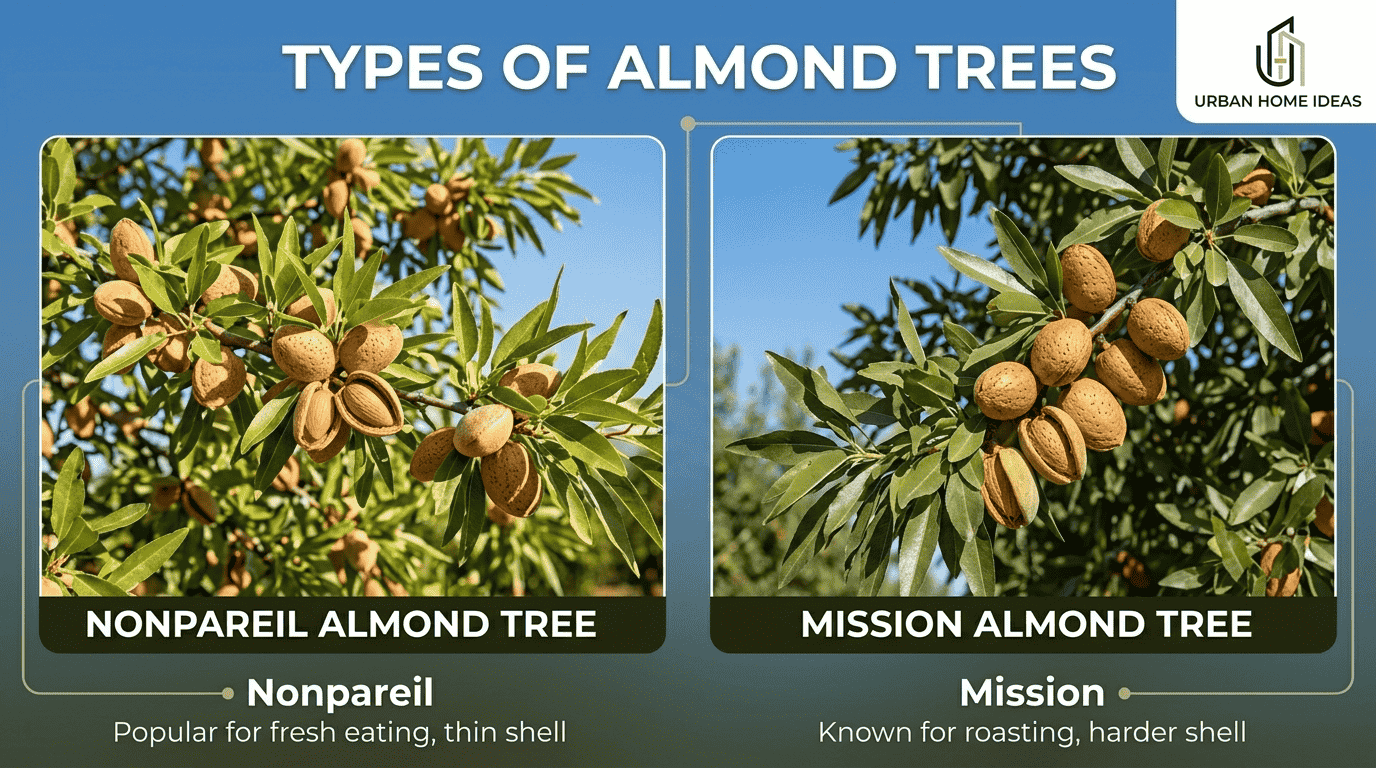
Different almond trees and varieties can vary in mature size, cold hardiness, flowering time, and pollination requirements.
A grower should therefore select a cultivar according to local climate, available garden space, and whether another compatible tree can be accommodated.
Sweet Almond Vs. Bitter Almond
Safety matters when distinguishing almond types. Sweet almonds are the familiar edible type generally offered by reputable nurseries for food production.
Bitter almonds are different because they can contain amygdalin in higher amounts.
This substance can contribute to cyanide poisoning, so bitter forms should not be treated like normal edible almonds.
Understanding different almond types and their potential toxicity is therefore important before consuming nuts from an unfamiliar tree.
Temperature And Climate Requirements
Successful almonds depend on a particular balance between winter and summer conditions.
Many cultivars have winter chilling requirements, but they subsequently benefit from a long frost-free growing period.
The sensitive period arrives when spring frost meets newly opened blossoms. A tree can tolerate winter cold yet lose flowers to a badly timed frost.
Later in the growing season, hot summers and relatively dry summers can encourage nut development.
From a UK-specific angle, warm locations and protected locations can make a noticeable difference. Early flowering means practical frost protection deserves attention.
Suitable south-facing positions may produce a warmer microclimate. Matching a cultivar to the local climate and typical temperature range is more reliable than treating every almond variety the same.
Propagating An Almond Tree
Reliable propagation is different from simply germinating a seed. Commercial-quality almond trees are commonly propagated by grafting onto a suitable rootstock.
For home gardeners who want reliable fruit production, buying an established nursery tree is usually more predictable than attempting uncertain propagation.
A known almond tree selected from properly identified grafted trees also gives the grower useful information about variety and rootstock.
Growing Almond Trees From Almonds
Using processed supermarket almonds as planting material is generally unreliable.
A viable fresh untreated almond may begin germinating and eventually develop into a tree, but producing a seedling does not guarantee predictable nuts.
The new tree may not reproduce the original named cultivar, including its desirable characteristics or fruit quality.
For anyone interested in growing almonds from seeds, genetic variation is part of the process. This is an important limitation of seed-based almond propagation.
Therefore, when a gardener asks how do you grow an almond tree from an almond, germination should be viewed as the beginning of an experiment rather than a guaranteed way to reproduce a productive cultivar.
Size And Rootstocks
Before planting, a grower should investigate rootstock information because it can influence the tree for its entire life.
St Julien and Brompton rootstocks are examples that may be encountered in almond cultivation.
The selected rootstock, together with pruning, can influence eventual tree size.
Compared with some other fruit trees, almonds are not always offered on the same modern dwarfing rootstocks used to produce very compact trees.
Expected almond tree size, natural growth, and rootstock compatibility should therefore be considered before choosing the planting position.
Almond Tree Varieties For UK Growing
Variety selection is particularly important where summers are cooler or spring frost is common.
Prunus dulcis, Robijn, and Ingrid are names a gardener may encounter when comparing almond varieties.
Characteristics such as productivity and disease resistance help distinguish potentially suitable almond tree varieties for UK growing.
Different cultivars of almonds should be matched to the actual growing site rather than selected solely by name.
Establishing Bare-Root Almond Trees Before Transplanting
Permanent planting does not always need to happen immediately. Bare-root almond trees can sometimes be established temporarily in temporary bags with reliable drainage.
This method can provide additional control during harsh weather. The trees still need to remain properly watered throughout the establishment period.
Where exposure is a concern, they can be supported against wind before being transplanted.
Once conditions are appropriate, the trees can move into a permanent ground position.
This temporary stage can give young trees useful protection. However, temporary containers should not become an unintended permanent growing system.
Careful transplanting helps preserve developing root establishment and minimizes disruption.
For someone still asking how do you grow an almond tree, this illustrates why flexibility matters. A grower should respond to weather, roots, variety, and site conditions rather than following a rigid routine.
FAQ
How to grow an almond tree from seed?
A grower wondering how do you grow an almond tree should start with viable raw almonds, proper soaking, and controlled chilling before planting. Using unroasted almonds helps support germination, while well-draining soil protects developing roots. With patience, healthy sprouted seeds can produce strong sprouts and gradually develop into a young almond tree.
How to grow an almond tree from seeds at home?
To understand how do you grow an almond tree, a gardener can start with viable raw almonds and prepare them carefully for germination. At home, unroasted almonds and unsalted almonds are better choices. Healthy almond seeds taken from whole almonds with shells can make growing from seeds practical and eventually produce an almond tree.
Other Post
America’s Gardening Resource: Smart Ideas For Better Gardens