

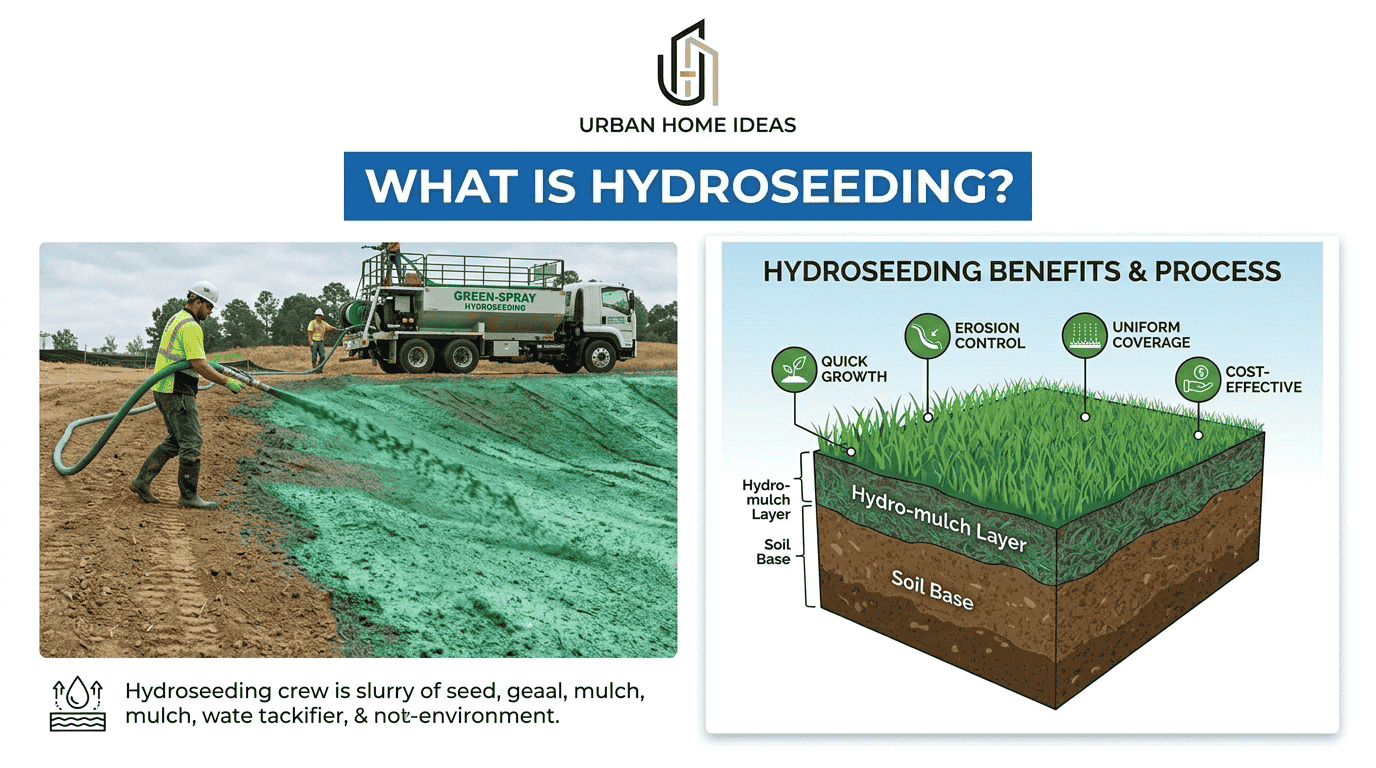
For anyone asking what is hydroseeding, it is a planting method that sprays grass seed, mulch, fertilizer, and water as a pressurized slurry over prepared soil. This specialized application supports grass establishment, erosion management, and large-area coverage, making it useful for a new lawn, slopes, difficult terrain, and large properties.
- What Is Hydroseeding Used?
- What’s In The Hydroseeding Mixture?
- Hydroseeding Pros And Cons / Advantages Of Hydroseeding
- Hydroseeding Vs. Traditional Seeding
- Hydroseeding Vs. Sod / Turf
- How Hydroseeding Works / The Hydroseeding Process
- Hydroseeding Vs. Dry Seeding
- Should You Hydroseed Your Lawn?
- Cost Of Hydroseeding
- Watering And Establishment
- Cost By Size
- Types Of Hydroseeding
- Services Related To Hydroseeding
- DIY Vs. Professional Cost
- Hydroseeding Vs. Hydromulching — What’s The Difference?
- Revegetation And Erosion Control
- Applications In Large Infrastructure Projects
- Historical Background
- Equipment And Technology
- Hydroseeding Is A One-Step Application
- Hydroseeding Applications And Use Cases
- Industrial And Infrastructure Projects
- Erosion Control And Land Rehabilitation
- Commercial Landscaping
- Residential Lawns
- Best Practices For Successful Hydroseeding
- Site And Soil Preparation
- Selecting The Right Seed And Mulch Blend
- Water Management During Establishment
- Frequently Asked Questions
- Can Hydroseeding Be Applied Over Existing Grass?
- How Long Does Hydroseeding Take To Establish?
- How Often Should Hydroseed Be Watered?
- Is Hydroseeding Worth The Cost?
- What Are The Disadvantages Of Hydroseeding?
- Can Heavy Rain Wash Hydroseed Away?
- How Long Should You Wait Before Walking On Hydroseed?
- Other Post
What Is Hydroseeding Used?

This planting method uses a liquid mixture of seed, mulch, fertilizer, and water for controlled spray application over prepared soil. The hydroseeding mixture improves soil coverage, supporting seed establishment, lawn establishment, grass growth, vegetation growth, and rapid growth. Proper soil preparation helps the planting process develop healthy grass and vegetation.
What’s In The Hydroseeding Mixture?
A hydroseeding mixture is a water-based mixture created for efficient seed application. Its main hydroseeding ingredients include water, seed, mulch, and fertilizer. This liquid mixture may also contain a tackifier binder, where the tackifier and binder help the mulch material and seed mixture stay distributed. The fertilizer component supports the overall planting mixture.
Seed Selection
Effective seed selection starts with the site rather than a favorite grass type. Suitable grass species, seed blends, native seed, or customized blends should match the climate, soil conditions, and intended use of the finished area.
For a residential site, appearance and lawn establishment may dominate the decision. On restoration sites, rehabilitation, local adaptation, and long-term vegetation performance may matter more.
The chosen seed should therefore match site conditions and project goals while supporting dependable germination.
Mulch
The mulch fraction performs much of its work before grass becomes visible.
A mixture containing wood fiber, paper fiber, or blended fiber can create a protective layer over the soil surface. This contributes to moisture retention, improves surface coverage, and gives developing seed additional protection.
The material also offers rainfall protection, helps limit the effects of wind protection concerns on exposed ground, and reduces seed displacement.
Within a hydroseeding slurry, these properties strengthen seed protection, support erosion control, and create a more stable environment for germination.
Fertilizers And Soil Enhancers
A correctly specified fertilizer supplies nutrients during the vulnerable early stage of establishment.
A starter fertilizer can provide essential nutrients for early growth, plant establishment, and initial rooting. Where the site contains poor soil or compacted soil, selected soil amendments and soil enhancers may help improve soil fertility.
The broader aim is stronger root development, steady vegetation growth, and appropriate germination support, rather than producing rapid surface color without a healthy root system.
Binders And Tackifiers
Binders and tackifiers help applied materials remain connected to the soil surface.
Their adhesion properties can improve seed retention, strengthen surface bonding, and provide greater washout resistance on steep slopes and other exposed sites.
By helping the seed, mulch, and slurry stay where they were applied, these materials contribute to stabilization and erosion control across vulnerable slopes.
Hydroseeding Pros And Cons / Advantages Of Hydroseeding
Anyone comparing methods after learning what is hydroseeding should also consider where the process performs well and where it demands extra management.
The primary hydroseeding advantages include large-area coverage, even seed distribution, uniform establishment, faster germination, soil stabilization, erosion control, and possible labor reduction.
The method also permits seed blend customization, grass species customization, and the use of suitable native seed mixtures.
For challenging sites, hydroseeding can address irregular terrain, steep slopes, and difficult access while contributing to dust reduction and reduced sediment runoff. As a sod alternative, it can also offer useful cost efficiency.
The hydroseeding disadvantages include the need for specialized equipment, ongoing watering requirements, temporary traffic restriction, and realistic expectations around establishment time.
Some sites additionally require tackifiers. Compared with traditional seeding, hydroseeding provides different operational advantages rather than being automatically superior in every situation.
Advantages
For large areas, hydroseeding can combine material delivery into a single application, resulting in faster application and potentially reduced labor.
Spray delivery can produce uniform coverage and even seed distribution over level ground as well as irregular ground.
The seed specification can include custom seed blends, customized grass species, native seed, or site-specific seed. This flexibility is valuable for ordinary lawns and rehabilitation projects.
The mulch-supported environment creates moist growing conditions, supporting faster establishment and uniform establishment.
Hydroseeding can also contribute to soil stabilization, erosion reduction, dust reduction, and sediment runoff reduction.
On steep terrain, slopes, or difficult-to-access ground, spray application adds practical convenience. Depending on the project, the method may deliver a lower cost than sod and a more consistent professional finish.
Disadvantages
Hydroseeding generally carries a higher cost than traditional seeding, particularly when a small project still requires equipment mobilization.
The establishment period also depends on a reliable watering schedule and often frequent watering, creating potentially substantial irrigation requirements.
A newly treated surface has delayed usability because of necessary traffic restriction. Its longer establishment than sod also means the finished lawn is not instantly available.
On steep slopes, tackifiers or additional erosion-control materials may be needed where washout risk is high.
The need for specialized machinery, professional equipment, and correct mixing contributes to the DIY difficulty of the process. Normal lawn maintenance remains necessary after establishment.
Hydroseeding Vs. Traditional Seeding
With conventional seeding, a contractor may complete separate operations for seed, fertilizer, mulch, and selected stabilization materials.
Hydroseeding can instead deliver these materials through a single controlled application across disturbed ground or large areas.
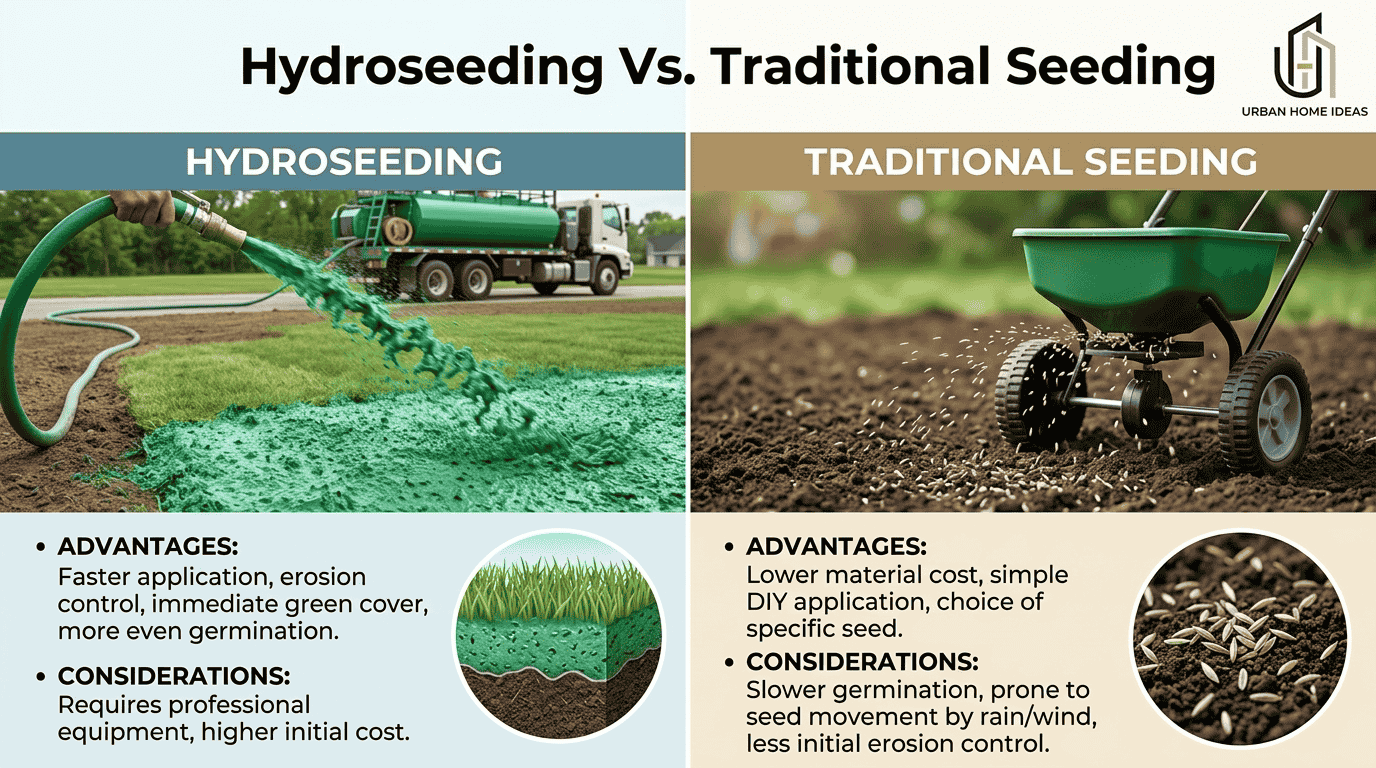
That difference can increase coverage efficiency, create more consistent coverage, and reduce visible patchiness.
It also permits seed blend customization and grass species customization. Favorable mulch and moisture conditions may support faster germination, although proper watering requirements still apply.
Standard broadcast seeding usually has a lower initial cost, making traditional seeding attractive where budget matters more than application speed.
The final choice should therefore consider the required establishment effort, site size, terrain, and desired finish rather than comparing seed prices alone.
Hydroseeding Vs. Sod / Turf
Sod is pre-grown turf installed over prepared ground. This explains its immediate grass surface, instant lawn appearance, and faster usability.
Hydroseeding takes another route because grass grows from selected seed choices and grass choices. The result can develop a more natural appearance while often carrying a lower cost than mature turf installation.
Across large spaces, slopes, embankments, and irregular terrain, hydroseeding can reduce material handling, freight, and physical labor associated with moving rolls of turf.
This advantage is particularly relevant for broadacre application.
The trade-off is longer establishment, with careful early watering and continued maintenance required before routine use.
Where an immediately finished surface is the main priority, professional installation of sod may still make more sense.
How Hydroseeding Works / The Hydroseeding Process
To understand what is hydroseeding in operational terms, the process can be viewed as preparation, mixing, spraying, and moisture management.
Work commonly starts with soil testing, season selection, grading, and detailed soil preparation.
The area should contain prepared soil with suitable conditions for seed-to-soil contact, while appropriate grass seed selection reflects climate, soil, and intended use.
Inside the hydroseeding equipment, water and selected slurry materials enter a tank.
Mechanical agitation keeps the components suspended. Where required, tackifiers are added before the mixture moves through a hose, spray tower, or cannon.
Controlled spray application helps create consistent coverage, including across uneven terrain.
After application, appropriate irrigation and often frequent watering help maintain surface moisture.
The objective is dependable germination without excessive seed displacement. Proper water control contributes to runoff prevention and also supports disease prevention by avoiding unnecessary saturation.
Hydroseeding Vs. Dry Seeding
With dry seeding, contractors may use broadcast seed or mechanical seeding before applying a separate surface material such as straw.
Loose material can be affected by wind, create clumping, produce uneven coverage, or result in seed displacement.
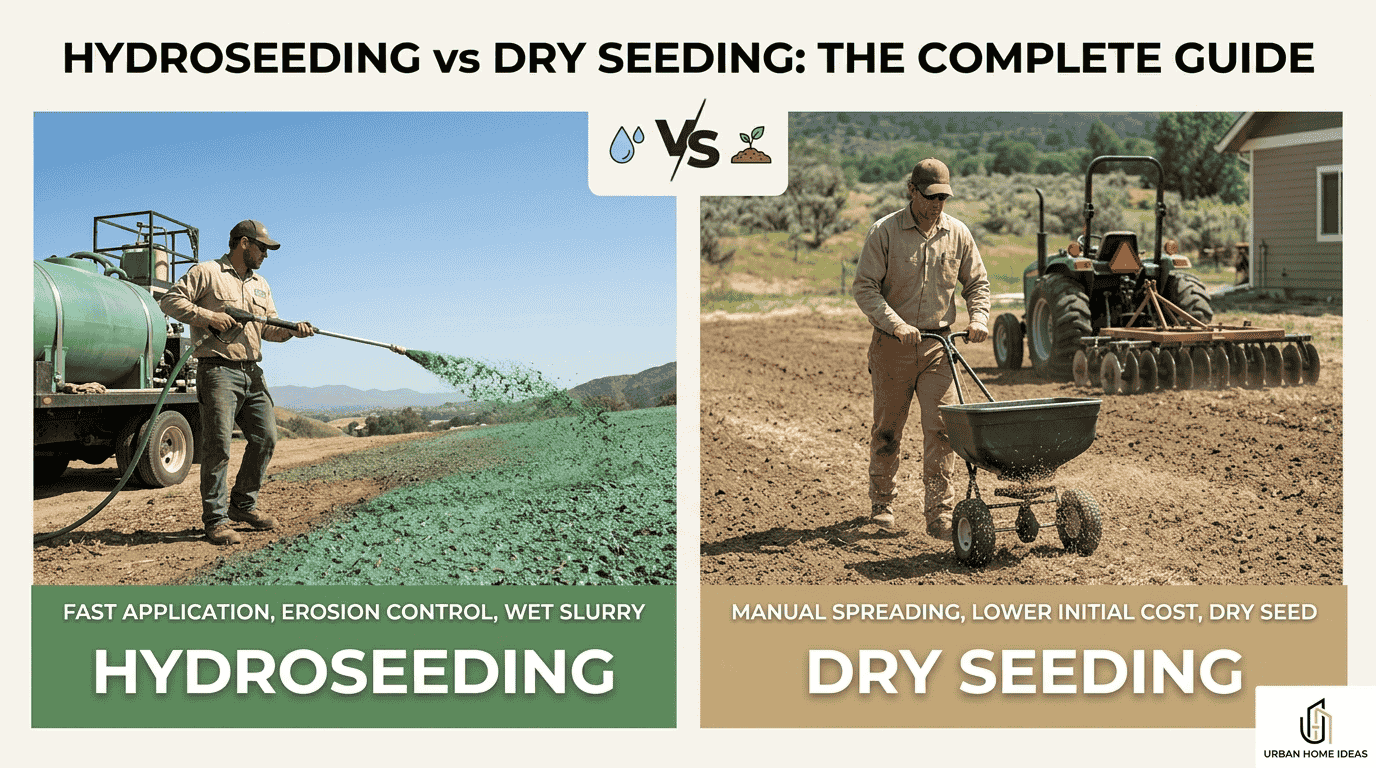
Additional protective material may therefore be required for seed protection and erosion control.
Hydroseeding suspends seed and mulch within a sprayed slurry and places both on the ground through simultaneous application.
That approach can improve uniform distribution, seed retention, and application efficiency because seed and protective materials reach the site together.
Should You Hydroseed Your Lawn?
The next question after understanding what is hydroseeding is whether the method actually suits the property.
A hydroseed lawn can be practical on large lawns, a large property, large spaces, a steep slope, or difficult-to-access locations.
Professional truck-based systems and professional application can cover these areas more efficiently than many manual techniques.
For small yards, equipment setup may reduce the economic advantage.
Likewise, where the owner requires an immediate lawn, sod may be a better fit.
Successful establishment still depends on dependable irrigation, a suitable watering schedule, sensible aftercare, and a genuine maintenance commitment.
The final test is sustained grass growth, not simply whether green slurry covered the site on application day.
Cost Of Hydroseeding
When evaluating what is hydroseeding worth financially, lawn size is only one part of the calculation.
Total hydroseeding cost can be influenced by labor cost, material cost, access, preparation requirements, seed type, and the complexity of installation.
Contractors often work from per-square-foot pricing, but every project cost can vary between a low estimate, average estimate, and high estimate.
A large lawn may achieve better unit efficiency because labor and machine mobilization are spread across more area.
A useful cost comparison should examine professional hydroseeding, traditional seeding, and sod on the basis of the complete installation rather than seed cost alone.
For reliable 2026 pricing, current local quotations are more useful than older generalized figures.
Sample sizes such as 2,000 square feet, 4,000 square feet, 6,000 square feet, 8,000 square feet, and 10,000 square feet can help property owners compare estimates on a consistent basis.
Watering And Establishment
A fresh hydroseed application is highly dependent on moisture during the first several weeks.
Many sites require frequent light watering, sometimes several times per day, although the correct schedule depends on weather conditions, soil, shade, and temperature.
The objective is consistent moisture within the surface soil without creating excess runoff.
Too much water can result in seed displacement and greater washout risk, while insufficient moisture can interrupt germination.
Effective moisture management supports root development and steady grass establishment.
The specific irrigation plan should therefore be adjusted to site conditions rather than followed blindly.
During the first month, foot traffic should be minimized. A temporary walking restriction helps protect young plants until ordinary new lawn care becomes appropriate.
Cost By Size
The relationship between hydroseeding cost and square footage is not completely linear because equipment mobilization, preparation, and labor remain part of every job.
| Lawn Area | Cost Consideration |
| 2,000 square feet | A small lawn can have higher unit pricing because setup costs are spread across less lawn area. |
| 4,000 square feet | Useful for comparing mid-sized project estimates. |
| 6,000 square feet | Material and labor increasingly influence the total project cost. |
| 8,000 square feet | Greater coverage can improve equipment efficiency. |
| 10,000 square feet | A large lawn may benefit from better economies of scale when access is straightforward. |
A useful quotation should distinguish likely low cost, average cost, and possible high cost rather than presenting one universal figure.
Types Of Hydroseeding
Different hydroseeding types are usually distinguished by slurry formulations, mulch choices, seed specifications, and application type.
Some projects may use paper-based mulch, while more demanding situations can require wood fiber, blended fiber, or another fiber mulch.
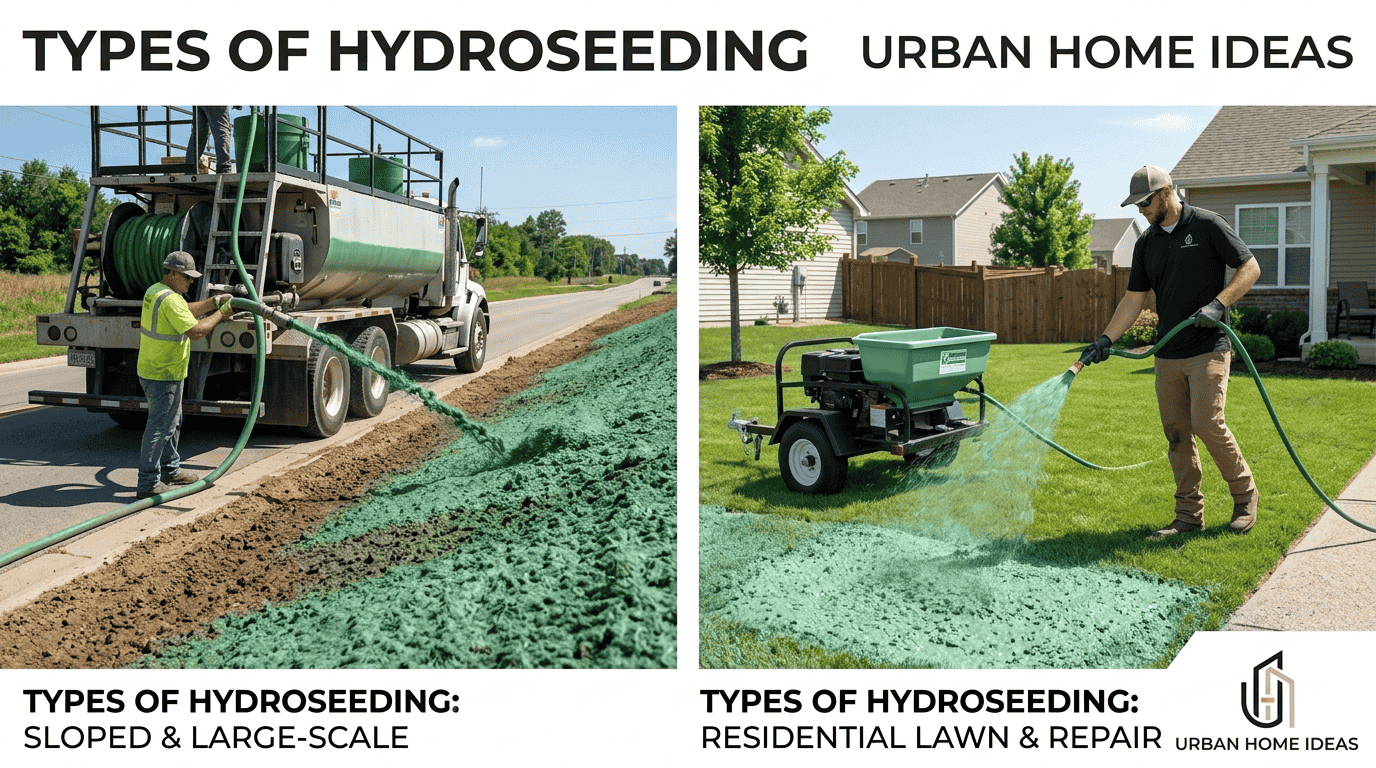
The choice should reflect climate, soil conditions, site requirements, and specific lawn objectives.
The seed mixture should also match the intended outcome, whether that is decorative grass, general vegetation establishment, or targeted erosion control.
Services Related To Hydroseeding
A hydroseeding project often involves more than spraying seed.
Associated hydroseeding services can include surface preparation, site preparation, soil preparation, grading, regrading, and yard leveling.
Some sites also need fill dirt, additional topsoil, improved drainage, or other forms of soil improvement before lawn installation begins.
Larger projects may include broader landscape work and landscaping.
Because these tasks can significantly affect the final project cost, a quotation should make clear which preparation work is already included.
DIY Vs. Professional Cost
A homeowner may consider DIY hydroseeding, particularly where an equipment rental is locally available.
However, true full-scale hydroseeding relies on correct agitation, slurry ratios, pump operation, and spray technique.
A small hose-mounted seed sprayer may suit patch repair or other small areas, but its application capacity is not equivalent to commercial equipment.
Professional hydroseeding generally involves a trained contractor, appropriate labor, specialized equipment, and professional machinery capable of delivering consistent coverage.
For a realistic comparison, the total project cost should include equipment, materials, preparation, labor, and the financial risk of repeating an unsuccessful DIY application.
Hydroseeding Vs. Hydromulching — What’s The Difference?
Hydroseeding and hydromulching are closely related, but their application purpose may differ.
Hydroseeding usually emphasizes vegetation establishment using seed, water, fertilizer, and mulch.
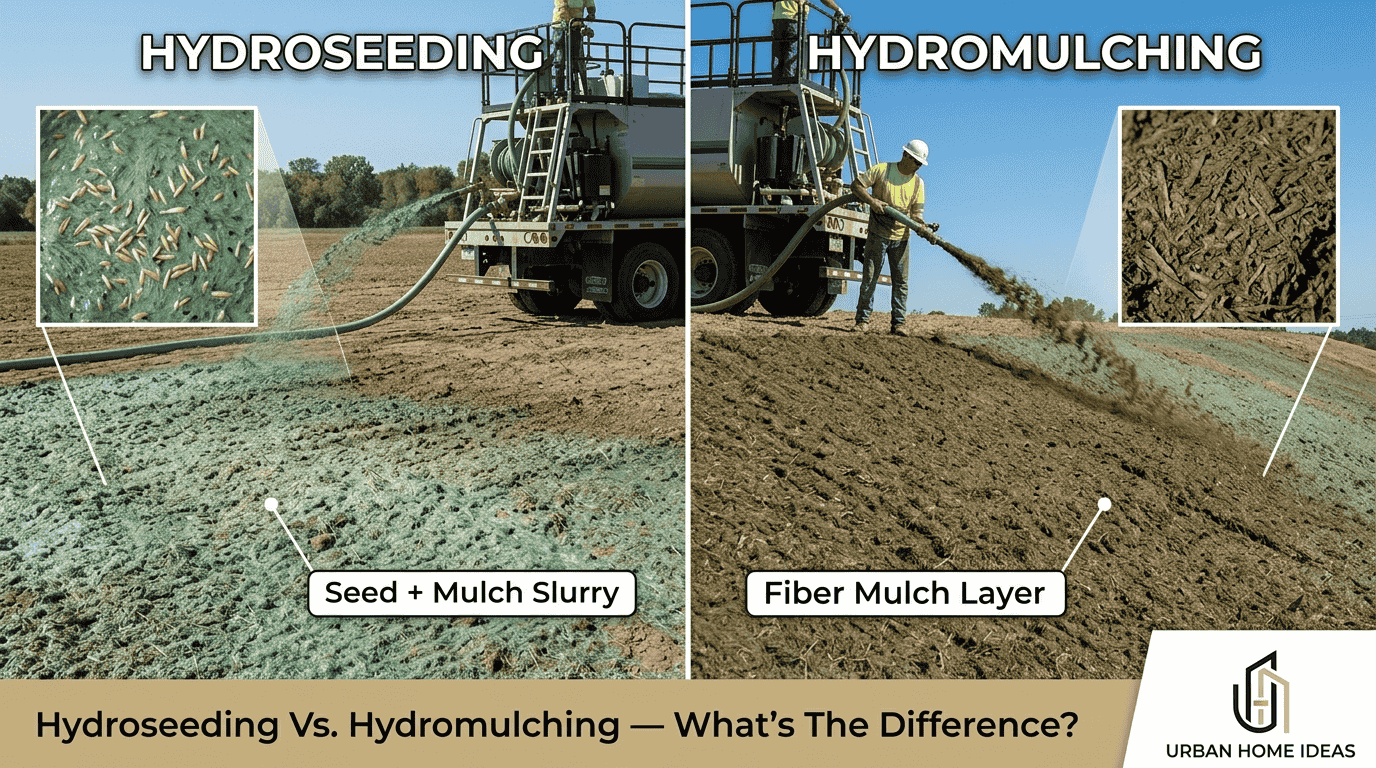
Hydromulching often places stronger emphasis on erosion control, soil stabilization, and surface protection.
Its slurry formulation may contain more fiber mulch, bonding agents, or tackifying agents to form a stronger protective layer.
Because industry terminology varies, the actual material specification is more useful than the service name alone.
Where slope stabilization is the main objective, the mulch type, tackifier, and application rate should reflect that requirement.
Revegetation And Erosion Control
Hydroseeding has an important role where disturbed soil requires rapid revegetation.
During early establishment, the mulch layer helps shield the soil from soil erosion while young plants begin vegetation establishment.
As root systems expand, they provide longer-term soil reinforcement and broader site stabilization.
Common locations include embankments, batters, stockpiles, and other exposed locations.
The combined effect of slope protection, runoff reduction, and erosion control makes hydroseeding useful within broader land rehabilitation work.
Applications In Large Infrastructure Projects
Large-scale hydroseeding can be used throughout infrastructure and civil projects where considerable disturbed ground needs stabilization.
Typical sites include highways, road corridors, rail corridors, pipelines, mining sites, subdivisions, bulk earthworks, and embankments.
On large areas, equipment-based spraying can improve labor efficiency, particularly across difficult slopes.
For construction work, the main value may involve combining vegetation establishment, site stabilization, and erosion control rather than simply producing an attractive grass surface.
Historical Background
The hydroseeding history is generally associated with the United States during the 1950s.
The early development of mechanized hydraulic seeding created another way to perform seed application across large areas and difficult ground.
Over time, the technique expanded from ordinary landscaping into civil construction, infrastructure, revegetation, and erosion control work.
That evolution positioned hydroseeding as a broader vegetation establishment method rather than only a residential lawn technique.
Equipment And Technology
Modern hydroseeding equipment is designed to mix, agitate, pump, and spray the slurry consistently.
Different machines offer different tank capacity, while mechanical agitation keeps seed, fertilizer, fiber mulch, and other additives suspended during slurry mixing.
A suitable pump system moves the material through a hose or cannon, producing a controlled spray.
These purpose-built machines range from compact units for landscaping work to large hydroseeders designed for extensive construction areas and landscaping areas.
Machine selection influences total coverage and overall application efficiency.
Hydroseeding Is A One-Step Application
A major operational advantage is the ability to place several hydroseeding ingredients into a single tank.
The formulation can combine seed, fertilizer, mulch, dye, water, and other materials as one pumpable slurry.
Instead of completing separate operations, the contractor performs a combined application.
This one-step application can achieve the required site coverage in one pass, potentially improving application efficiency and labor efficiency while supporting vegetation establishment.
Hydroseeding Applications And Use Cases
Looking at what is hydroseeding across real sites shows that the technique extends well beyond residential grass.
Common hydroseeding applications and hydroseeding use cases include residential lawns, commercial landscaping, industrial projects, and major infrastructure projects.
Typical areas include large yards, open areas, common spaces, verges, road corridors, rail corridors, embankments, slopes, and drainage areas.
The technique is also used around subdivisions, new construction, and earthworks, where vegetation establishment, soil stabilization, erosion control, and land rehabilitation are often linked objectives.
Depending on the site, hydroseeding may function as a dry seed alternative or a practical turf alternative.
Industrial And Infrastructure Projects
For industrial projects and infrastructure projects, hydroseeding can support rapid stabilization across extensive areas.
Typical locations include road corridors, rail corridors, earthworks, embankments, drainage areas, and slopes.
A large-scale application can quickly cover exposed ground, supporting vegetation establishment and erosion control around civil construction projects.
Erosion Control And Land Rehabilitation
Newly disturbed land may require temporary stabilization before vegetation becomes strong enough to provide permanent stabilization.
A mulch layer offers immediate soil protection, helps with runoff reduction, and contributes to erosion control.
As root systems establish, they strengthen disturbed soil, improve slope stabilization, and contribute to longer-term vegetation establishment.
These characteristics can make hydroseeding useful in broader environmental rehabilitation and land rehabilitation programs.
Commercial Landscaping
In commercial landscaping, hydroseeding can be used around subdivisions, large commercial developments, and other landscape projects.
It performs well across common spaces, open areas, and verges, particularly where large-area coverage and uniform coverage are important.
Careful site preparation remains essential for dependable lawn establishment and durable vegetation.
Residential Lawns
For homeowners, hydroseeding is often considered for residential lawns, large yards, large properties, and new construction.
It provides a turf alternative and an alternative to conventional dry seed, while allowing suitable grass seed to be selected for local conditions.
Reliable irrigation, careful aftercare, good lawn establishment practices, and extra planning around slopes are still required.
Best Practices For Successful Hydroseeding
Effective hydroseeding best practices begin before the slurry reaches the soil.
Proper site preparation, soil preparation, grading, and debris removal determine whether the application has a suitable surface.
A contractor should review soil conditions, soil compaction, climate, slope, and intended use before completing seed selection and choosing the mulch blend.
The specification should also define sensible application rates and any specific stabilization requirements.
After spraying, consistent water management, suitable surface moisture, and careful attention to weather conditions support germination while reducing washout risk.
Site And Soil Preparation
Successful site preparation starts with the actual soil condition.
Existing drainage, the depth and quality of topsoil, and any excessive soil compaction should be reviewed before work begins.
Debris removal, surface grading, and leveling can produce more consistent prepared ground.
The final soil preparation should create a workable seedbed with reliable seed-to-soil contact.
That gives young plants a better opportunity for strong root establishment.
Selecting The Right Seed And Mulch Blend
Appropriate seed selection depends on climate, soil conditions, slope, and intended use.
Depending on the site, contractors may use different seed varieties, individual grass species, or native seed.
The objective should be dependable vegetation establishment, not simply rapid surface color.
The mulch blend and mulch formulation should receive the same attention.
An appropriate fiber mulch and application rate should support germination while satisfying site-specific stabilization requirements.
Water Management During Establishment
Effective water management keeps enough soil moisture available for germination without creating excessive runoff.
The correct watering frequency varies with weather conditions, soil type, shade, and the overall establishment period.
Consistent surface moisture and good moisture retention encourage root development.
Excessive watering, however, can create seed displacement and increase washout risk.
Although the mulch layer helps regulate moisture, appropriate irrigation remains essential.
Frequently Asked Questions
For readers still evaluating the method, these hydroseeding FAQs address common concerns about hydroseeding cost, lawn establishment, existing grass, establishment time, and possible hydroseeding disadvantages.
They also cover watering frequency, irrigation, washout, heavy rain, walking on hydroseed, routine maintenance, grass growth, and protecting a new lawn.
Can Hydroseeding Be Applied Over Existing Grass?
For an existing lawn, hydroseeding can be applied directly over existing grass, but professionals generally do not recommend this direct application as the first choice. The application method depends on the grass surface, and a professional recommendation may favor preparation before any hydroseeding application.
How Long Does Hydroseeding Take To Establish?
For most sites, hydroseeding needs 4 to 8 weeks to establish a functional lawn or thick lawn. Initial germination and seed germination often begin in 5 to 10 days, but the full germination period, early growth, grass growth, vegetation establishment, lawn establishment, establishment time, developing lawn, and lawn development continue beyond that stage.
How Often Should Hydroseed Be Watered?
During initial germination phase, hydroseed needs frequent watering 2 to 3 times per day, 5 to 15 minutes per session. Irrigation schedule sets daily watering frequency and watering duration, keeping damp mulch consistently damp like a wet sponge; surface moisture retention supports germination, seed establishment, lawn establishment, and early growth.
Is Hydroseeding Worth The Cost?
For a large property or sloped yard, professional hydroseeding is often worth the cost because it offers slope coverage and affordable lawn establishment at a fraction of the price of laying sod. This budget-friendly option improves cost efficiency for large area lawn installation compared with sod installation.
What Are The Disadvantages Of Hydroseeding?
Common hydroseeding disadvantages include a higher cost than seed, reliance on specialized equipment, and greater DIY difficulty than standard seeding.
The establishment period also requires frequent watering, regular maintenance, and temporary traffic restriction.
Poor weather or difficult terrain can create washout risk, while the developing lawn is generally slower than sod to become usable.
Can Heavy Rain Wash Hydroseed Away?
Yes. Heavy rain can contribute to hydroseed washout, especially on a steep slope or where concentrated runoff crosses the application.
A suitable tackifier, enough mulch, and appropriate surface protection can help reduce seed displacement.
Effective erosion control planning should also consider local weather conditions, drainage patterns, soil characteristics, and slope length.
How Long Should You Wait Before Walking On Hydroseed?
Limiting walking on hydroseed helps protect young seedlings during the early stages of germination and root development.
During the first month, unnecessary foot traffic should generally be avoided.
This temporary traffic restriction provides additional surface protection while grass establishment progresses.
Normal lawn care can gradually resume as the new lawn develops enough strength and density to tolerate regular use.
Other Post
America’s Gardening Resource: Smart Ideas For Better Gardens